

🧠 6sense: AI-Powered B2B Revenue Intelligence and Intent Data Platform
6sense is an enterprise B2B revenue intelligence platform that uses AI, predictive analytics, buyer intent data, and account intelligence to help sales and marketing teams identify which companies are most likely to buy, understand what those companies are researching, and decide when and how to engage them.
Unlike general-purpose AI tools such as ChatGPT or Claude, 6sense is not designed primarily for writing, coding, image generation, or everyday productivity. Its focus is much narrower: helping B2B companies find high-value accounts and turn buying signals into sales and marketing actions.
🏢 What Is 6sense?
6sense is a B2B SaaS company focused on revenue intelligence, account-based marketing, buyer intent data, sales intelligence, and AI-powered go-to-market operations. The company was founded in 2013 by Amanda Kahlow and a team that wanted to use predictive analytics and machine learning to help B2B organizations identify potential buyers earlier in the purchasing process.
6sense launched its predictive B2B sales and marketing platform in the mid-2010s and gradually expanded its product from predictive analytics into account identification, intent data, ABM, advertising, sales intelligence, buyer data, and AI-powered revenue workflows.
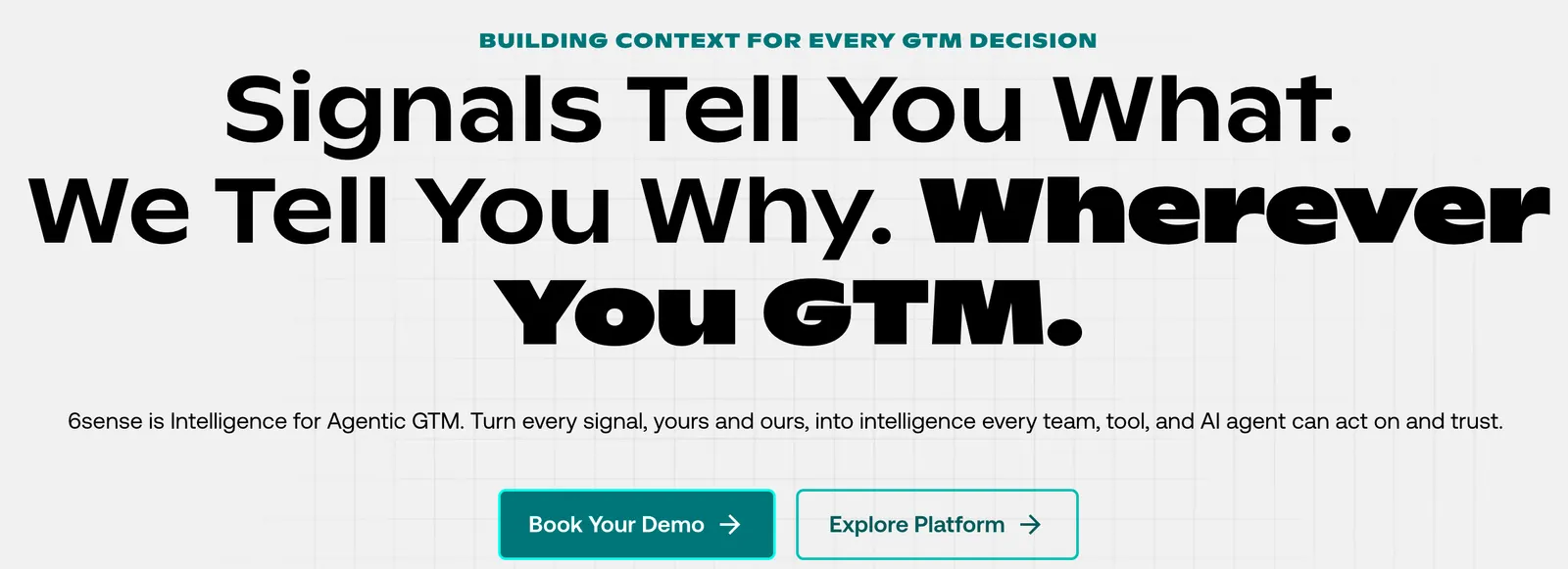
Today, 6sense positions itself as a GTM intelligence platform designed to turn signals from buyers, websites, CRM systems, intent providers, and other data sources into actionable intelligence for sales, marketing, and revenue teams.
The problem it addresses is straightforward: B2B companies often have large amounts of customer and prospect data, but that data does not always reveal which accounts are actively researching a solution or which prospects deserve attention right now. 6sense attempts to turn that scattered information into account priorities, buying-stage predictions, and recommended sales and marketing actions.
⚙️ Core Features of 6sense
1. 🔎 B2B Intent Data
Intent data is one of 6sense's most important capabilities. The platform looks for signals that indicate a company may be researching a product, technology, category, or business problem. Depending on the available data, these signals can include web behavior, content consumption, keyword research, and other digital activity.
2. 🎯 Account Identification and Prioritization
Rather than treating every lead equally, 6sense helps revenue teams prioritize accounts based on factors such as ideal customer profile fit, intent, engagement, behavioral signals, and predicted buying activity.
This is especially useful for sales teams responsible for hundreds or thousands of accounts. Instead of simply asking which companies exist in the database, sales teams can focus on which accounts appear to deserve attention now.
3. 🤖 Predictive AI and Buying-Stage Analysis
6sense uses machine learning and predictive analytics to estimate which accounts are more likely to purchase and where they may be in the buying journey. This helps sales and marketing teams allocate resources toward accounts that appear to have stronger commercial potential.
4. 👤 Buyer and Account Intelligence
The platform provides information about companies, contacts, technologies, buying behavior, keywords, and other business signals. This helps sales representatives understand not only who a company is, but also why that company may be relevant at a particular moment.
5. 📣 Account-Based Marketing and Advertising
6sense can turn account intelligence into marketing audiences and campaigns. Marketing teams can use high-intent account segments for targeted advertising, campaign personalization, website experiences, and other ABM activities.
6. ✉️ AI-Powered Sales Assistance
6sense includes AI-powered capabilities that can help sales representatives create more personalized outreach. Its AI features can use account information, intent signals, and other available context to help generate more relevant sales messaging.
7. 🔄 CRM and GTM Integrations
6sense is designed to work alongside existing revenue technology. It supports integrations with systems such as Salesforce, HubSpot, Microsoft Dynamics, marketing automation platforms, and sales engagement tools.
8. 🌐 Chrome Sales Intelligence Extension
The 6sense Sales Intelligence Chrome extension allows licensed users to access company and contact intelligence while working across supported environments such as LinkedIn, company websites, Salesforce, Salesloft, Outreach, and HubSpot.
⭐ What Makes 6sense Different?
The biggest difference is that 6sense is not simply a database of business contacts. Its value comes from combining company information, behavioral signals, intent data, predictive models, and activation tools.
A conventional B2B database might tell a salesperson that a company has 2,000 employees and uses Salesforce. 6sense attempts to go further by identifying whether that company appears to be researching a relevant solution, what topics it is interested in, how strong its buying signals are, and whether the account should receive attention from the sales team.
Another important advantage is the connection between marketing and sales. Marketing teams can identify target accounts while sales teams work from the same account-level intelligence rather than maintaining completely separate prospect lists.
6sense also has a long history with predictive analytics. Machine learning and predictive modeling have been central to the company's product direction since its early development, rather than being added only recently as a marketing feature.
💼 Real-World Use Cases
📈 B2B Sales Prospecting
Sales representatives can prioritize accounts showing stronger buying signals instead of working through a large account list without knowing which prospects are more active.
🎯 Account-Based Marketing
Marketing teams can create target-account segments based on company characteristics, intent, engagement, technology usage, and other criteria, then use those segments in campaigns.
📊 Pipeline Generation
Revenue teams can identify companies that appear to be researching a solution and use those signals to support earlier and more relevant sales outreach.
✉️ Personalized Outreach
Sales teams can use account and intent information to make outbound messages more specific instead of relying on the same generic email template for every prospect.
🌐 Website Personalization
Companies can use account-level intelligence to create more relevant digital experiences for different audiences and high-value target accounts.
📢 Advertising
Marketing teams can use account segments and intent signals to make B2B advertising more targeted and reduce spending on accounts that are unlikely to become valuable opportunities.
🤝 Sales and Marketing Alignment
6sense can provide a shared account-level intelligence layer so marketing and sales teams can work from similar priorities instead of operating from disconnected lead lists.
Important: 6sense is not a strong choice for general writing, programming, graphic design, student homework, or personal productivity. Its value is concentrated in B2B go-to-market work.
🚀 How to Use 6sense
Step 1: Create or Obtain a 6sense Account
6sense is primarily an enterprise B2B platform, so the onboarding process is different from signing up for a consumer AI chatbot. Companies typically evaluate the platform, discuss their requirements with 6sense, and receive access according to their subscription.
Step 2: Define Your Ideal Customer Profile
Before using predictive and intent features, the team should clearly define the accounts it wants to win. This may include industry, company size, geography, revenue, technology stack, business model, and other criteria.
Step 3: Connect CRM and Marketing Systems
For a serious deployment, connecting systems such as Salesforce, HubSpot, Microsoft Dynamics, or supported marketing automation platforms is an important step. This allows 6sense to combine existing first-party data with its intelligence layer.
Step 4: Build Account Segments
Create groups based on ICP characteristics, intent, engagement, account stage, geography, industry, or other business requirements.
Step 5: Analyze Buying Signals
Review which accounts are showing meaningful activity and what topics or products they appear to be researching.
Step 6: Prioritize Sales Activity
Use the resulting account intelligence to determine which companies should receive sales attention, advertising, personalized content, or other forms of engagement.
Step 7: Activate the Data
This is where 6sense becomes commercially useful. Instead of simply looking at dashboards, teams can push intelligence into sales workflows, advertising campaigns, CRM processes, email outreach, and other GTM activities.
💡 Practical Tips for Getting Better Results
1. Start With a Narrow ICP
Trying to monitor the entire market from day one can create unnecessary noise. Start with a clearly defined group of accounts and expand after the team understands which signals actually correlate with opportunities.
2. Do Not Treat Intent as a Guaranteed Purchase
An intent signal means an account appears to be researching a topic. It does not mean the company has approved a budget or is ready to sign a contract. Intent should be treated as a prioritization signal, not proof of purchase intent.
3. Combine Intent With Account Fit
A company showing strong activity can still be a poor customer fit. Likewise, a perfect ICP account with no meaningful buying activity may not deserve immediate outreach. The strongest approach combines fit, intent, engagement, and business context.
4. Use AI for Personalization, Not Blind Automation
AI-generated sales messages are more useful when a representative reviews them before sending. Account-specific information should make the message more relevant rather than simply making it longer.
5. Bring Intelligence Into Existing Workflows
If salespeople have to constantly leave Salesforce or their sales engagement platform to check another dashboard, adoption can suffer. Integrations and browser-based sales intelligence are valuable because they bring information closer to where salespeople already work.
6. Measure Revenue Outcomes
Do not evaluate 6sense only by the number of accounts identified. More useful metrics include qualified pipeline, opportunity creation, win rate, deal velocity, campaign efficiency, and revenue influenced by the platform.
💻 Installation and Access
| Platform | Availability | Notes |
|---|---|---|
| Web | Yes | Primary way to access the 6sense platform. |
| Windows | Web-based | No traditional Windows desktop application is required. |
| macOS | Web-based | Can be accessed through a supported browser. |
| iOS | Not a primary native app | 6sense is mainly designed for professional web and sales workflows. |
| Android | Not a primary native app | Not positioned as a consumer mobile AI application. |
| Chrome Extension | Yes | Available for supported Sales Intelligence users. |
| Salesforce | Yes | Supported integration and sales intelligence workflows. |
| HubSpot / Microsoft Dynamics | Yes | Supported CRM integration options are available. |
The Chrome extension is particularly useful for sales teams. Licensed users can access intelligence while working with LinkedIn, company websites, CRM environments, and supported sales engagement platforms.
💰 6sense Pricing
6sense does not use the typical consumer AI pricing model of charging an individual user a small monthly subscription. It is primarily an enterprise B2B platform, with pricing generally customized according to factors such as product scope, data requirements, user access, integrations, and the level of sales and marketing orchestration required.
| Plan Type | Typical Positioning | Pricing |
|---|---|---|
| Free | Not positioned as a full free consumer AI product | No general free tier comparable to ChatGPT Free |
| Sales Intelligence | Sales teams needing account and contact intelligence | Custom quote |
| Revenue Marketing | ABM, intent, campaign, and revenue marketing teams | Custom quote |
| Enterprise | Large organizations requiring broader data, AI, and orchestration | Custom quote |
Third-party sources have historically reported annual contract values ranging from tens of thousands of dollars to significantly higher enterprise deployments. These figures should not be treated as official list prices because 6sense does not publish one universal public pricing table.
For a serious buyer, the better question is not simply "How much does 6sense cost?" but "How much qualified pipeline and revenue can it realistically generate compared with the cost of the platform and implementation?"
👥 Who Should Use 6sense?
- B2B marketing teams: Especially teams focused on ABM and demand generation.
- Enterprise sales teams: Useful when representatives manage large account territories.
- Revenue operations teams: Useful for connecting CRM, intent, account, and marketing data.
- Demand generation teams: Helpful for identifying and activating accounts that appear to be entering a buying cycle.
- ABM teams: A natural fit for account-level targeting and personalized campaigns.
- Large B2B companies: Particularly relevant when the value of a new customer justifies sophisticated sales intelligence.
- Enterprise-focused agencies: Potentially useful when managing sophisticated account-based campaigns.
It is generally not intended for students, casual users, individual bloggers, designers, software developers looking for a coding assistant, or consumers looking for a general-purpose AI chatbot.
🌎 Global Usage and Market Position
6sense is a global B2B software platform rather than a consumer application, so download counts are not a particularly useful measure of adoption. The company does not publish a reliable global monthly active-user number comparable to consumer AI products.
6sense serves organizations across North America, Europe, Asia-Pacific, Latin America, and other international markets. Its platform is particularly relevant in markets with mature B2B sales and marketing operations, including the United States, Canada, the United Kingdom, Germany, Australia, and other major enterprise markets.
The platform has substantial visibility in the B2B sales, marketing, ABM, intent-data, and revenue-operations categories. Its presence on major B2B software review platforms and adoption among enterprise revenue teams provide stronger indicators of market presence than app download numbers.
However, it would be misleading to claim that 6sense has a specific number of millions of active users or to provide an exact country-by-country user ranking without reliable company disclosure. Enterprise SaaS adoption is normally measured through customers, contracts, revenue teams, and business outcomes rather than app downloads.
👍 Advantages of 6sense
1. Strong Intent Data
Intent data is one of the platform's clearest strengths. It gives revenue teams more context than a conventional company database.
2. Excellent for Account-Based Marketing
6sense is built around accounts rather than treating every individual lead as an isolated record. That fits the way many enterprise B2B sales organizations operate.
3. Predictive Analytics and AI Are Central to the Product
Predictive modeling has been part of 6sense's product strategy for years, making AI closely connected to the platform's revenue intelligence capabilities.
4. Strong Sales and Marketing Integration
The platform connects marketing targeting, buyer intelligence, sales prioritization, CRM workflows, and advertising rather than focusing on only one part of the funnel.
5. Useful Data Inside Existing Workflows
The Chrome extension and CRM integrations make the intelligence more practical for salespeople who do not want to constantly switch between applications.
⚠️ Disadvantages of 6sense
1. Expensive for Small Companies
6sense is an enterprise platform. Its pricing structure can be difficult to justify for a small business with a limited sales team or relatively low customer lifetime value.
2. Learning Curve
There is a lot happening inside the platform, including intent data, account scoring, segmentation, campaigns, predictive models, integrations, and sales intelligence. Teams need time and training to use it properly.
3. Setup Requires Good Data
6sense cannot magically fix a poorly defined ICP or messy CRM. Integrations, account mapping, data quality, and sales processes still matter.
4. Intent Signals Can Be Misinterpreted
Intent is a signal, not a purchase order. A company researching a topic does not automatically mean it is ready to buy. Sales teams still need human judgment.
⚖️ 6sense vs. Similar B2B Sales and Marketing Tools
| Tool | Main Strength | Intent / AI | Typical Use | Pricing Approach |
|---|---|---|---|---|
| 6sense | Revenue intelligence and ABM | Very strong | Enterprise B2B sales and marketing | Custom enterprise pricing |
| ZoomInfo | B2B contact and company intelligence | Strong | Prospecting and sales intelligence | Custom pricing |
| Apollo.io | Prospecting and sales engagement | Moderate to strong | Outbound sales and lead generation | More accessible tiered pricing |
| Demandbase | ABM and account intelligence | Strong | Enterprise ABM | Custom pricing |
| Factors.ai | Marketing attribution and buyer journey analytics | Strong analytics | Marketing intelligence | Custom / plan-based |
If the main requirement is a large contact database and outbound prospecting, ZoomInfo or Apollo.io may be a better starting point. If the priority is sophisticated account-based marketing and buyer intent, 6sense becomes much more interesting.
6sense's closest strategic competitors are platforms such as Demandbase rather than general AI assistants. Comparing it directly with ChatGPT misses the point: ChatGPT helps an employee perform knowledge work, while 6sense is designed to help an entire B2B revenue organization decide where to focus its commercial resources.
🔐 Data, Integrations and Enterprise Considerations
For enterprise buyers, the integration architecture is almost as important as the AI itself. 6sense can connect with CRM and marketing systems so that account information, campaigns, predictive signals, and sales activity can be used together.
Salesforce, HubSpot, and Microsoft Dynamics are among the CRM environments supported by 6sense, while marketing automation and sales engagement integrations can extend the platform into broader GTM workflows.
This is why 6sense should not be evaluated simply as a dashboard. Its value increases when it becomes part of the company's existing revenue process.
🧪 Practical Assessment
From a B2B marketer's perspective, 6sense solves a real problem: sales teams rarely have enough time to investigate every potentially valuable account. A platform that identifies stronger buying signals and puts those signals into the sales workflow can reduce wasted prospecting effort.
There is an important catch, though. 6sense is not a magic lead-generation machine. If the ICP is wrong, CRM data is poor, sales follow-up is weak, or the organization has no clear ABM strategy, an expensive intelligence platform will not automatically fix those problems.
The strongest use case is a company with a meaningful B2B sales operation, relatively high-value contracts, multiple salespeople, and enough marketing activity to generate useful behavioral data.
🏁 Final Verdict: Is 6sense Worth Using?
Overall rating: 8.5/10 for enterprise B2B revenue teams; 5/10 for small businesses and individual users.
6sense is one of the more sophisticated platforms in the B2B revenue intelligence and account-based marketing category. Its biggest advantage is the combination of intent data, predictive analytics, account intelligence, AI-powered recommendations, and sales and marketing activation.
6sense is worth considering if:
- You run an enterprise or mid-market B2B sales organization.
- Your sales team manages a large number of target accounts.
- You are investing seriously in account-based marketing.
- You need better visibility into early-stage buyer activity.
- You want marketing and sales to work from a shared account intelligence layer.
6sense is probably not a good fit if:
- You are a solo founder or small business with only a handful of prospects.
- You mainly need email automation or a simple contact database.
- You are looking for a general-purpose AI assistant.
- Your CRM and customer data are not yet organized.
- You cannot clearly measure the revenue impact of a sophisticated ABM platform.
The bottom line is simple: 6sense is not an AI chatbot with a sales feature attached. It is an enterprise revenue intelligence system built around B2B buying signals. For the right sales and marketing organization, that distinction is exactly why it is valuable. For everyone else, it can be an expensive platform solving a problem they do not actually have.
Comments