

🔎 What Is AlsoAsked?
AlsoAsked is an SEO research and content planning tool built around Google's People Also Ask (PAA) results. It was created by Mark Williams-Cook and the team behind Candour, a UK digital marketing agency. The product began as an alpha project in 2019 and later developed into a commercial SEO research platform.
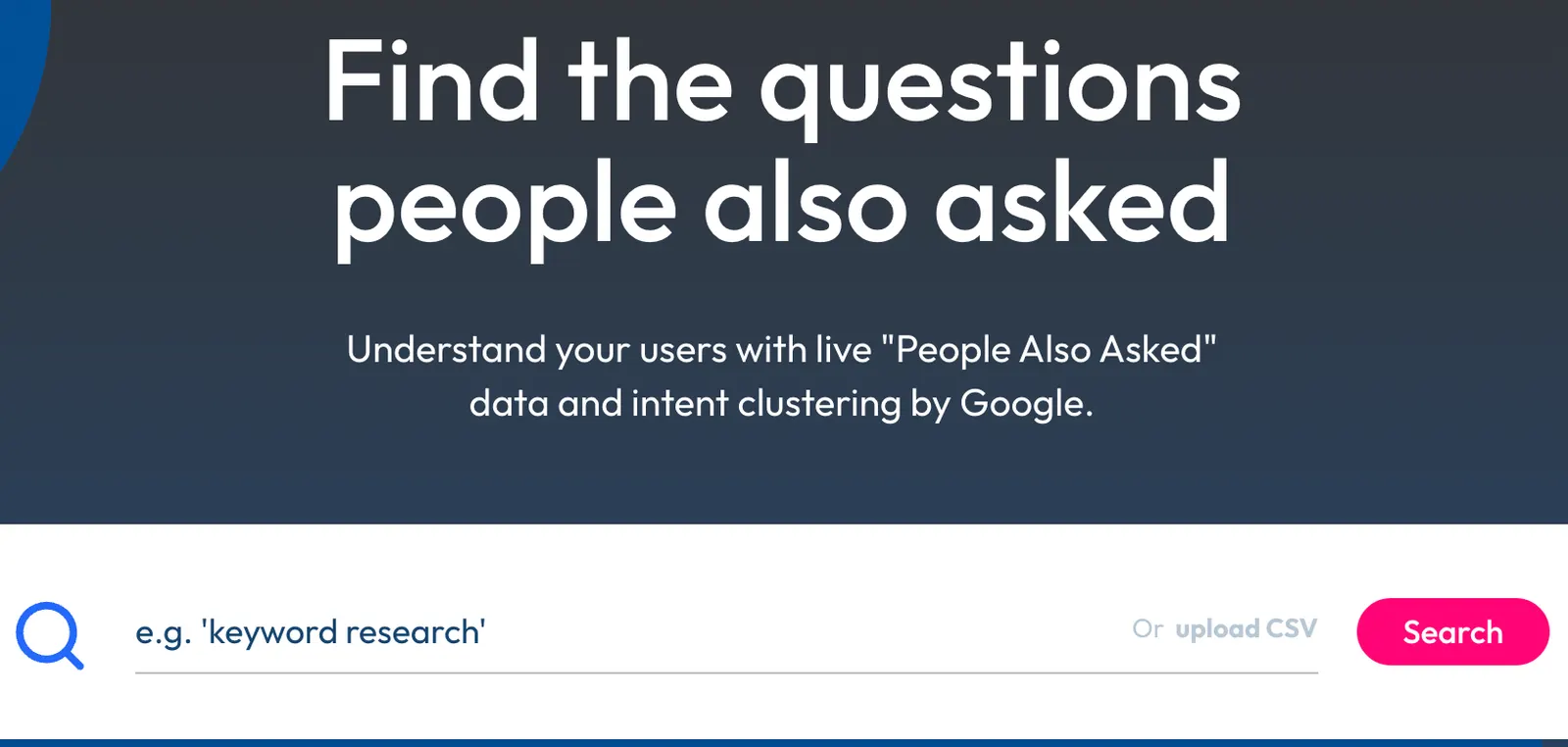
The basic idea is simple: instead of treating a keyword as one isolated search phrase, AlsoAsked shows the related questions Google associates with that topic and organizes them into a branching question tree.
For example, if you search for "best running shoes", Google may show related questions about how to choose running shoes, how long they last, whether expensive shoes are worth buying, and which shoes are suitable for different types of runners. AlsoAsked connects these questions so you can see how the topic develops.
This makes the tool particularly useful for SEO research, search-intent analysis, content planning, FAQ research, keyword discovery, and content briefs.
It is important to understand that AlsoAsked is not primarily a general-purpose AI chatbot. Its core value comes from collecting and organizing Google's People Also Ask data. The product is therefore closer to an SEO research tool than to ChatGPT or Claude.
🧩 Core Features
🌳 1. People Also Ask Question Trees
The main feature is a visual question tree that displays related questions around a search topic. Instead of receiving a flat list of keywords, you can see how one question leads to another.
🔍 2. Google PAA Research
AlsoAsked retrieves People Also Ask information from Google search results. This gives content researchers a direct way to investigate the questions Google is currently associating with a topic.
🌎 3. Country, City and Language Targeting
You can specify the country, location, and language used for a search. This is particularly useful for international SEO because the questions appearing around the same keyword can vary between markets.
🔬 4. Deep Search
Deep Search expands the question tree further than a standard search. It is useful when researching broad subjects, building pillar pages, or looking for deeper subtopics. Deep Search consumes more search credits than a standard query.
📁 5. Bulk Search
Paid plans support bulk research, allowing users to work with multiple keywords instead of researching every topic individually. This is useful for agencies, large websites, and large-scale content planning.
📊 6. CSV and PNG Export
Research results can be exported as CSV files for further analysis or as PNG images for content briefs, presentations, client reports, and editorial meetings.
⚙️ 7. API Access
AlsoAsked provides API access for users who want to connect PAA research with their own applications, dashboards, SEO systems, or automated content workflows.
🔌 8. MCP Support
Paid plans also provide MCP support, allowing AlsoAsked data to be incorporated into compatible AI-assisted workflows and development environments.
⭐ What Makes AlsoAsked Different?
The most useful way to understand AlsoAsked is to focus on search-intent mapping rather than the word "AI."
Traditional keyword research tools generally provide large datasets containing keywords, search volume, keyword difficulty, CPC, traffic estimates, and ranking information. Those metrics are useful, but they do not always show how different questions are connected.
AlsoAsked takes a narrower approach. It shows the relationships between questions appearing in Google's People Also Ask results. For a content writer, that can provide a much clearer picture of what a page should actually cover.
For example, someone researching "home coffee machines" may discover questions about machine types, maintenance, coffee quality, price, cleaning, beginner suitability, and long-term costs. These questions can then be grouped into sections for a more complete article.
The geographic controls are another useful feature. A content team targeting the United States can research the US market separately from the UK, Canada, Australia, or another region instead of assuming that the same question structure applies everywhere.
The result is a tool that is intentionally narrow. It does not try to be an all-in-one SEO platform. Its job is to help answer one specific research question: what questions are people seeing around this topic in Google, and how are those questions related?
💼 Practical Use Cases
📝 SEO Content Planning
This is the clearest use case. Start with a primary keyword, expand the PAA tree, identify recurring questions, and use those questions to build a more complete article structure.
📚 Blog Research
Writers can use AlsoAsked before starting an article to discover supporting questions and potential subtopics. This is useful when the main topic is clear but the writer is unsure what readers expect the article to answer.
🎯 Search Intent Analysis
Repeated questions can provide clues about what users want to know. You can use the question groups to distinguish informational, commercial, comparison, troubleshooting, and other search intents.
🌎 International SEO
International SEO teams can research the same subject across different countries and languages. This helps identify differences in user questions instead of simply translating an English content plan.
📣 Content Marketing
Marketing teams can turn PAA questions into blog topics, FAQ sections, video ideas, newsletter subjects, social media content, and customer education material.
🛒 E-commerce
E-commerce teams can research questions around product categories and use the results to improve buying guides, product education pages, category content, FAQs, and comparison articles.
🤖 SEO and GEO Research
AlsoAsked can be useful when planning content for modern search and AI-assisted discovery. Understanding the questions associated with a topic can help content teams cover a subject more completely instead of optimizing an article around a single keyword.
👨💻 SEO Automation
Developers can use the API to collect PAA data and feed it into internal SEO dashboards, content management systems, research tools, or automated workflows.
🚀 How to Use AlsoAsked
Step 1: Enter a Topic
Start with a keyword or question. For example:
"best project management software"
Step 2: Select the Target Market
Choose the country, location, and language that match your target audience. This is particularly important when doing international SEO research.
Step 3: Run the Search
AlsoAsked retrieves available People Also Ask questions and presents them as a visual relationship map.
Step 4: Study the Question Relationships
Look for recurring themes and related questions. Do not automatically copy every question into your article. Instead, identify the broader topic represented by each group.
Step 5: Use Deep Search When Needed
If you are working on a broad topic or building a comprehensive content cluster, Deep Search can reveal additional branches. Because it consumes additional credits, it is better used selectively.
Step 6: Export Your Research
Export the results as CSV if you want to sort and analyze the questions, or use PNG when you need a visual overview for a client or editorial team.
Step 7: Build the Content Structure
Group related questions into logical sections. Some questions may deserve a dedicated article, while others can be answered within a larger guide or FAQ section.
🧠 Tips for Better Results
1. Start Broad, Then Go Specific
If the initial query is extremely narrow, Google may have limited PAA information available. Starting with a broader topic often gives you more useful branches to investigate.
2. Search From the User's Perspective
Do not only research commercial keywords. Try question-based searches such as "how does...", "why does...", "is it worth...", and "which is better...". These can reveal different stages of the user's search journey.
3. Compare Different Markets
If your website serves multiple countries, run the same topic in several markets. Differences in the PAA results can reveal local content opportunities that a translated keyword list might miss.
4. Use Deep Search Strategically
Deep Search is useful for important topics, but it does not need to be used for every keyword. It consumes four search credits, so save it for topics where deeper research can actually improve the content plan.
5. Look for Themes Instead of Copying Questions
One common mistake is turning every PAA question into a separate heading. Several questions may represent the same underlying concern. Combine them into a useful section instead of producing an article that feels like a list of search queries.
6. Combine AlsoAsked With Traditional SEO Tools
AlsoAsked focuses on questions and their relationships. It does not replace the search-volume, keyword-difficulty, backlink, ranking, and competitor data provided by comprehensive SEO platforms.
A practical workflow is AlsoAsked for questions and search intent → an SEO platform for demand and competition → human analysis for the final content strategy.
💻 Installation and Supported Platforms
AlsoAsked is primarily a web-based SEO research service. There is no complicated desktop installation process.
- Web: Fully supported and the primary way to use AlsoAsked.
- Windows: No dedicated Windows application is necessary. Use the web version.
- Mac: No dedicated Mac application is necessary. Use the web version.
- iPhone: The service is primarily accessed through a mobile browser rather than a dedicated native app.
- Android: The service can be accessed through a mobile browser.
- Browser Extension: A browser extension is not required for the core AlsoAsked workflow.
- API: Available for users who want to integrate PAA research into software or automated processes.
- MCP: Available on current paid plans for compatible AI-assisted workflows.
For professional SEO research, the desktop browser is the better option because large question trees, exports, bulk research, and content planning are much easier to handle on a larger screen.
💰 AlsoAsked Pricing
AlsoAsked offers limited free searching along with paid plans. Its current paid pricing is relatively simple compared with large SEO suites.
| Plan | Price | Monthly Credits | Main Use |
|---|---|---|---|
| Free / Trial | Limited free searches | Limited | Testing the service and occasional research |
| Basic | $12/month | 100 | Individual SEO and content research |
| Lite | $23/month | 300 | Regular SEO and content work |
| Pro | $47/month | 1,000 | Agencies and high-volume research |
Annual billing provides a discount compared with monthly billing. Paid plans include features such as deeper searches, exports, bulk searches, API access, and other research capabilities.
Additional credits can also be purchased when the included monthly allocation is not enough. Deep Search consumes four credits, so users conducting large-scale research should factor that into their actual usage.
The pricing is one of AlsoAsked's more approachable aspects. It is considerably cheaper than subscribing to a full enterprise SEO suite if your main requirement is question research.
👥 Who Should Use AlsoAsked?
- SEO professionals: One of the most obvious target audiences.
- Content strategists: Useful for building article structures and topic clusters.
- Copywriters: Helps identify questions that should be answered in long-form content.
- Digital marketing agencies: Bulk research, exports, API access, and multiple-user support are useful for client projects.
- Content publishers: Useful for researching large numbers of topics and planning editorial calendars.
- International SEO teams: Country, location, and language targeting is particularly useful for multinational websites.
- E-commerce marketers: Useful for buying guides, FAQs, category pages, and product education content.
- Developers: Useful when PAA data needs to be integrated into an internal application or automated workflow.
- Students: Helpful for exploring questions around a research topic, although a paid subscription is probably unnecessary for occasional use.
- General users: Useful for deeper topic research, but it is unnecessary for someone who only wants basic search suggestions.
🌎 Global Usage
AlsoAsked does not currently publish a reliable, audited figure for active users, monthly active users, downloads, or country-by-country user distribution. For that reason, traffic estimates should not be presented as official user numbers.
The company has previously reported providing more than 9 million search results during its 2.5-year beta period. This is a useful indicator of historical usage, but it should not be interpreted as the current number of users.
The service supports multiple countries, cities, and languages, which gives it a genuine international SEO use case. SEO professionals can research different markets rather than relying on one English-language PAA dataset.
AlsoAsked is primarily a professional SEO and content research product, so its audience is very different from consumer AI applications. Its users are more likely to be SEO specialists, marketers, publishers, agencies, and content teams than general consumers.
The tool has also become relevant to discussions about AI-generated search results. Recent analysis based on a large AlsoAsked dataset found a high proportion of PAA answers appearing to be AI-generated. Such studies should be treated as independent analysis of sampled search results rather than official Google statistics.
⚖️ Pros and Cons
Pros
- Very focused: AlsoAsked concentrates on one specific SEO research problem rather than trying to become an entire marketing platform.
- Visual question relationships: The tree structure is more useful for content planning than a simple list of related keywords.
- Google PAA research: The product is directly connected to the questions appearing in Google search results.
- Strong international targeting: Country, location, and language controls make it useful for international SEO.
- Useful export and automation options: CSV, PNG, bulk searches, API, and MCP support make the tool practical for professional workflows.
Cons
- No traditional keyword metrics: It does not replace tools that provide search volume, keyword difficulty, CPC, backlink, and competitor data.
- Dependent on Google PAA availability: If Google does not display useful PAA results for a query, AlsoAsked may have limited information to work with.
- Deep Search uses more credits: A Deep Search consumes four credits, which matters when researching hundreds of topics.
- Not an AI writing platform: It helps with research and planning, but users still need another tool or a human writer to produce the finished content.
🔍 AlsoAsked vs. Similar SEO Tools
| Tool | Main Focus | Primary Data | Best Use | Pricing Position |
|---|---|---|---|---|
| AlsoAsked | People Also Ask research | Google PAA questions and relationships | Search intent, FAQs, content planning | Free option; paid plans from $12/month |
| AnswerThePublic | Question and topic discovery | Search suggestions and autocomplete data | Broad content ideation | Free and paid plans |
| Ahrefs | Complete SEO research | Keywords, backlinks, rankings, competitors | Professional SEO and competitive research | Professional subscription pricing |
| Semrush | SEO and digital marketing suite | Keywords, rankings, backlinks, competitors, advertising and content data | SEO, marketing, competitor research | Professional subscription pricing |
| Google Keyword Planner | Keyword research | Google Ads keyword data and estimates | Keyword demand and advertising research | Available through Google Ads |
AlsoAsked is much narrower than Ahrefs or Semrush. That is not necessarily a weakness. If you need backlinks, technical SEO, competitor rankings, search-volume estimates, and large keyword databases, you need a more comprehensive platform.
If your question is specifically "What questions are appearing around this topic in Google, and how are they connected?", AlsoAsked is much more focused.
AnswerThePublic is another useful comparison. It is primarily designed for broad question and search-suggestion discovery, while AlsoAsked focuses specifically on Google's People Also Ask results and their relationships.
📈 How AlsoAsked Fits Into SEO and GEO
AlsoAsked can be particularly useful as one component of a broader SEO and GEO workflow.
Instead of asking an AI tool to invent questions about a topic, you can first investigate questions that are actually appearing in Google search results. Those questions can then be used as research inputs for your content strategy.
A practical workflow looks like this:
- Start with a primary topic or keyword.
- Run an AlsoAsked search for the target country and language.
- Expand important branches with Deep Search.
- Group similar questions according to search intent.
- Use an SEO platform to check search demand and competition.
- Create a content outline around the most important question groups.
- Write complete answers instead of simply inserting keywords.
- Use AI tools for drafting, editing, and research assistance where appropriate.
- Review important facts manually before publication.
- Repeat the research periodically because search results and user behavior change.
This approach is more practical than treating GEO as simply adding more keywords to AI-generated content. The objective is to understand the questions surrounding a topic and create content that answers those questions clearly and completely.
📝 Final Verdict: Is AlsoAsked Worth Using?
AlsoAsked is worth using if SEO content research is a regular part of your work. Its strongest feature is its narrow focus. It does not attempt to replace ChatGPT, Ahrefs, Semrush, or a content management system. Instead, it provides a structured view of Google's People Also Ask questions.
For SEO professionals, content strategists, agencies, publishers, and marketing teams, this can save a meaningful amount of research time. The visual question tree is especially useful for pillar pages, FAQ sections, content clusters, buying guides, and detailed content briefs.
The international search controls are another reason to consider it. If your website targets several countries, you can investigate how questions differ between markets rather than simply translating the same content strategy.
However, AlsoAsked should not be treated as a complete SEO platform. It does not provide the same depth of keyword volume, keyword difficulty, backlink, competitor, ranking, or technical SEO information available from comprehensive SEO tools.
The product also depends on Google PAA availability. Some keywords will naturally produce better results than others, and extensive Deep Search usage can consume credits relatively quickly.
Bottom line: AlsoAsked is a specialized SEO research tool, not a general-purpose AI assistant. It is a good fit for anyone who needs to understand search questions and build content around real user intent. It is less useful for people who primarily need keyword-volume data, competitor research, AI writing, or general-purpose AI assistance.
For a professional content operation, one of the most sensible ways to use it is alongside other tools: AlsoAsked for question discovery and search-intent mapping, an SEO platform for keyword and competition data, and an AI writing assistant for drafting and refinement. In that role, AlsoAsked fills a specific gap without requiring you to replace the rest of your SEO workflow.
Comments