

What Is Amazon Nova? A Complete Guide
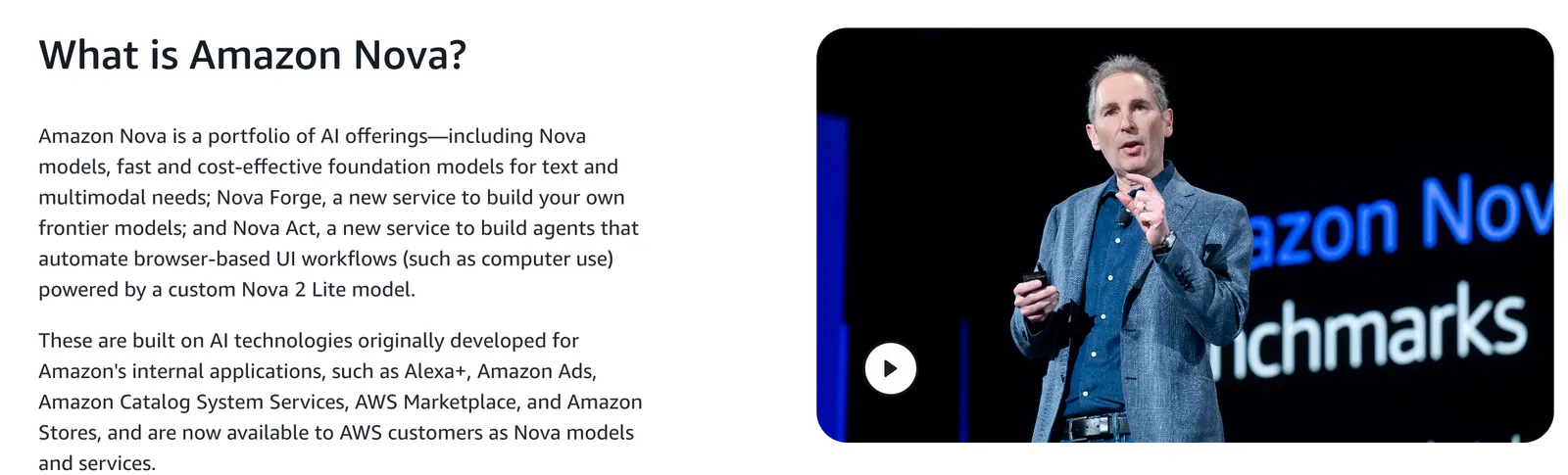
Amazon Nova is AWS's proprietary family of foundation models — not a single model, but a full suite of specialized AI models designed for different tasks: text understanding, image generation, video creation, voice interaction, browser automation, and multimodal embeddings. Unlike third-party models hosted on Bedrock (like Claude or Llama), Nova is built by Amazon itself, giving AWS deep control over the entire stack from training to deployment.
Nova models are accessed exclusively through Amazon Bedrock's unified API. There is no standalone app, no downloadable software, and no consumer-facing chatbot. This is an enterprise-grade, developer-first platform — and that distinction matters. If you're looking for a ChatGPT-like experience, Nova isn't that. But if you're building production AI applications that need multimodal intelligence, cost efficiency, and tight AWS integration, Nova is one of the most compelling options available in 2026.
The Nova family spans two major generations. The original Nova 1.0 lineup launched in late 2024, and the Nova 2 series arrived at re:Invent 2025 with significant upgrades in reasoning, multimodal processing, and context window sizes. As of mid-2026, the Nova 2 models are the recommended choice for new projects.
Core AI Features and Model Lineup
Nova's model family is organized into three functional categories, each purpose-built for specific workloads:
Understanding Models (Input → Text Output)
- Nova Micro: A text-only model optimized for speed and cost. It generates over 200 tokens per second with a 128K token context window. Ideal for classification, summarization, translation, and high-volume simple tasks where latency matters most.
- Nova Lite: A low-cost multimodal model that handles text, images, and video (up to 30 minutes). The Nova 2 Lite version supports a 1-million-token context window — one of the largest in the industry. Great for document analysis, visual Q&A, and real-time customer service.
- Nova Pro: A high-performance multimodal model balancing accuracy, speed, and cost. Supports complex reasoning, multi-step agent workflows, API calling, and can serve as a teacher model for knowledge distillation. Context window: 300K tokens.
- Nova Premier: The most capable model in the lineup, designed for complex reasoning tasks and primarily used as a teacher model for distilling smaller, cost-effective custom models.
Creative Content Generation Models
- Nova Canvas: An image generation model supporting text-to-image, image-to-image, inpainting, outpainting, and background removal. Includes built-in watermarking and content moderation for responsible AI use.
- Nova Reel: A video generation model supporting text-to-video and image-to-video with controllable camera motion and pacing. Can generate multi-shot videos up to 2 minutes long.
Voice and Agent Models
- Nova Sonic: A speech-to-speech model that unifies voice understanding and generation in a single model. Supports tone and pace awareness for natural conversational AI, available in five languages (English US/UK, French, Italian, German, Spanish).
- Nova Act: An agent model purpose-built for browser automation. It executes UI workflows with over 90% task reliability at scale, trained through reinforcement learning in synthetic web environments. Ideal for web QA testing, data entry, data extraction, and checkout automation.
- Nova Multimodal Embeddings: A unified embeddings model supporting text, image, document, video, and audio inputs for semantic search, recommendation systems, and similarity matching.
Cross-Cutting AI Capabilities
- Built-in Tools: Nova includes out-of-the-box tools like a Code Interpreter (executes Python in a sandboxed environment) and Web Grounding (built-in RAG that retrieves real-time web information with source citations to reduce hallucinations).
- Model Context Protocol (MCP): An open standard allowing Nova to discover and connect to external tools and data sources automatically, without custom adapter code.
- Structured Output: Nova uses constrained decoding to guarantee valid JSON output conforming to developer-defined schemas — critical for agent workflows and API integrations.
- 200+ Language Support: Understanding models support over 200 languages for both comprehension and generation.
- Model Customization: Supports pretraining, supervised fine-tuning (SFT), reinforcement fine-tuning (RFT), and model distillation for building domain-specific variants.
Key Highlights That Make Nova Stand Out
- Industry-leading cost efficiency: AWS positions Nova as delivering up to 75% lower costs compared to similar-tier models on Bedrock, making it one of the most affordable options for high-volume enterprise workloads.
- Vertical integration: Because Amazon builds both the models and the infrastructure, Nova achieves tight optimization across the entire stack — from training hardware to inference serving. This is especially evident in Nova Act, where the model, orchestration layer, tools, and SDK are co-trained for reliability.
- Native Bedrock integration: Nova plugs directly into Bedrock's Knowledge Bases, Agents, Guardrails, and the broader AWS ecosystem (Lambda, S3, DynamoDB, OpenSearch, EventBridge), reducing integration complexity.
- Responsible AI built in: All generated content includes digital watermarks. Customizable Content Moderation Settings (CCMS) let enterprises tune safety controls across four categories: safety, sensitive content, fairness, and security. Child safety and privacy protections are non-configurable and always enforced.
- Cross-region inference: Nova supports automatic multi-region request routing, prioritizing the origin region to minimize latency while improving reliability — with billing based only on the source region, no extra routing fees.
- Nova Forge: A custom model training service launched at re:Invent 2025, allowing enterprises to train frontier models tailored to their specific data and use cases. Reddit, for example, used Forge to build a content moderation model that outperformed commercially available alternatives.
️ How to Get Started with Amazon Nova
Nova is a cloud API service accessed through Amazon Bedrock. There is nothing to download or install locally. Here's the setup path:
- Create an AWS Account: Sign up at aws.amazon.com if you don't have one. New accounts may qualify for free tier credits.
- Enable Model Access: Open the Amazon Bedrock console, navigate to "Model access," and request access to the specific Nova models you want to use. Some models require a brief use-case description before approval.
- Configure IAM Permissions: Ensure your IAM user or role has the
AmazonBedrockFullAccesspolicy (or a custom policy withbedrock:InvokeModelandbedrock:InvokeToolpermissions). - Install the AWS SDK:
pip install boto3 - Set Up Credentials: Configure your AWS credentials via environment variables, AWS CLI (
aws configure), or an IAM role if running on EC2/Lambda. - Make Your First API Call:
import boto3

client = boto3.client("bedrock-runtime", region_name="us-east-1")

response = client.converse(
    modelId="amazon.nova-pro-v1:0",
    messages=[{
        "role": "user",
        "content": [{"text": "Summarize the key benefits of Amazon Nova."}]
    }]
)

print(response["output"]["message"]["content"][0]["text"])
For Nova Act (browser automation), you'll also need the Nova Act SDK and can start with the interactive Playground at nova.amazon.com/act before moving to the Kiro IDE extension for development.
Practical Tips for Using Nova Effectively
- Choose the right model tier: Don't default to the most powerful model. Use Nova Micro for classification and simple text tasks, Nova Lite for multimodal workloads where cost matters, and reserve Nova Pro/Premier for complex reasoning. The cost difference between tiers is dramatic — Nova Micro costs roughly $0.035 per million input tokens, while Nova Pro is $0.80 per million.
- Use batch inference for offline workloads: If you don't need real-time responses (e.g., bulk document processing, sentiment analysis), batch inference cuts costs by 50% with results returned within 24 hours.
- Leverage prompt caching: For repeated or similar prompts, cache reads are 75% cheaper than on-demand input tokens. This is a massive saver for chatbots and RAG applications with recurring context.
- Set temperature to 0 for tool use: When using Nova with function calling or structured output, setting
temperature: 0enables greedy decoding, which significantly improves tool call reliability and output consistency. - Use Web Grounding instead of building RAG from scratch: If your use case requires up-to-date factual information, Nova's built-in Web Grounding tool handles retrieval and citation automatically — no need to build and maintain a separate RAG pipeline.
- Break complex tasks into smaller steps: Nova's tool invocation has retry limits. For multi-step workflows, decompose tasks into smaller, well-defined steps rather than asking the model to handle everything in one call.
- Crop images for small text extraction: Nova has limited ability to read small text in images. If you need OCR-like extraction, crop the image to focus on the relevant text region and increase source resolution.
- Configure extended timeouts: Complex Nova inference requests (especially with reasoning mode or code interpretation) can take up to 60 minutes. Set
read_timeout=3600in your botocore config to avoid premature timeouts.
Global Usage and Adoption
Amazon Nova operates differently from consumer AI apps, so traditional metrics like app store downloads don't fully capture its reach. Here's what the data tells us:
- Consumer app presence: A product called "Nova" appeared at #5 in global AI app monthly active users (MAU) with 71.45 million users as of April 2025, and ranked #8 in global AI app downloads in April 2026. It also accounted for approximately 4.35% of total generative AI tool downloads in the preceding year. Note: It is not entirely clear from available data whether this "Nova" refers to Amazon's Nova or a separate consumer product with the same name — treat these figures with that caveat.
- Enterprise adoption: Amazon has publicly stated that approximately 1,000 internal generative AI applications use Nova models across its business units. External enterprise customers include SAP, Deloitte, Palantir, Volkswagen Group, Slack, Cognigy, and Bynder, among others.
- Partner ecosystem: Major technology partners including Weaviate (vector database), Coactive (video intelligence), and Dentsu Digital have integrated Nova Multimodal Embeddings into their platforms.
- Regional availability: Nova models are available across multiple AWS regions including US East (N. Virginia), US West (N. California), Europe (London, Stockholm, Frankfurt, Ireland, Paris), Asia Pacific (Tokyo, Seoul, Mumbai, Singapore, Sydney), and AWS GovCloud (US).
- Market context: While Nova competes with models from OpenAI, Google, Anthropic, and Meta, AWS's strategy emphasizes cost-performance leadership and deep platform integration rather than chasing benchmark-topping raw performance. As of late 2025, some industry observers noted that certain AWS customers still supplement Nova with third-party models like Gemini and GPT for specific use cases, though Nova 2's improvements have narrowed that gap considerably.
Pricing: How Much Does Nova Cost?
Nova is a paid service with a tiered pricing structure. There is no free tier for Nova specifically, though new AWS accounts may receive general service credits. Here's the breakdown:
Understanding Models (Per 1,000 Tokens)
| Model | Input (per 1M tokens) | Output (per 1M tokens) |
|---|---|---|
| Nova Micro | $0.035 | $0.14 |
| Nova Lite | $0.06 | $0.24 |
| Nova Pro | $0.80 | $3.20 |
Nova 2 Series (Per 1,000 Tokens)
| Model | Input (per 1M tokens) | Output (per 1M tokens) |
|---|---|---|
| Nova 2 Lite | $0.39 | $3.21 |
| Nova 2 Pro (Preview) | $1.61 | $12.84 |
| Nova 2 Omni (Preview) | $0.40 (text/image/video), $1.30 (audio) | $3.20 (text), $52.00 (image) |
Other Services
- Nova Act: $4.75 per agent hour (real-world elapsed time while an agent is working)
- Nova Forge: Annual subscription starting at $100,000/year for custom model training
- Batch Inference: 50% discount off on-demand rates for non-real-time workloads
- Cache Read Input: 75% discount off on-demand input token pricing
- Service Tiers: Standard (regular rates), Priority (preferential compute for mission-critical apps), and Flex (discounted pricing for workloads that can tolerate delayed processing)
For the most current and region-specific pricing, always check the official Amazon Bedrock pricing page, as rates are updated regularly.
️ Common Issues and How to Fix Them
Access and Authentication Errors
Model access denied: The most common issue. You must explicitly request model access in the Bedrock console before making API calls. Navigate to "Model access," select the Nova models you need, and submit the request. Also verify your IAM role has AmazonBedrockFullAccess or equivalent permissions.
Regional availability: Not all Nova models and features are available in every region. Web Grounding, for example, is currently limited to US regions with US CRIS profiles. If a feature returns an unexpected error, verify regional availability and switch regions if needed.
API Response Issues
Response truncated (max_tokens): The output was cut off because it hit the token limit. Increase the maxTokens parameter in your inferenceConfig. For reasoning mode, you may also need to unset temperature, topP, and maxToken to let the model use optimal settings.
Content filtered: The model refused to generate output due to a Responsible AI policy violation. Review your input for potentially sensitive content. If the filter is too aggressive for your use case, contact your AWS account manager about Customizable Content Moderation Settings (CCMS).
Timeout on complex operations: Nova inference requests can take up to 60 minutes for complex tasks. Configure read_timeout=3600 in your botocore Config object.
Tool Use Problems
Tool not being called: Set toolChoice to {"any": {}} to ensure at least one tool is always called, and set temperature: 0 for deterministic behavior.
Web Grounding not working: Ensure your IAM policy includes the bedrock:InvokeTool action for the amazon.nova_grounding system tool resource. Also check that Service Control Policies (SCPs) aren't blocking the request by restricting aws:requestedRegion.
Custom tool name conflicts: Never create a custom tool named nova_grounding — this conflicts with the built-in system tool. Use the systemTool configuration instead of toolSpec for built-in tools.
Media Processing Limitations
Small text in images unreadable: Crop the image to focus on the relevant text area and increase source resolution. If text is critical, provide it separately as text input.
Person identification refused: By design, Nova models refuse to identify or name individuals in images, documents, or videos for privacy and safety reasons. Ask about general characteristics or scene context instead.
PDF processing failures: PDFs using CMYK color profiles or containing SVG images may fail. Convert to RGB color profile and rasterize SVG images before submission.
Final Thoughts
Amazon Nova represents AWS's most serious commitment to building a vertically integrated AI model ecosystem. Its strength isn't any single benchmark score — it's the combination of cost efficiency, multimodal breadth, enterprise security, and deep platform integration that makes it a compelling choice for teams already invested in the AWS ecosystem.
For developers evaluating AI platforms in 2026, Nova deserves serious consideration — particularly if your priority is cost-effective, production-grade AI at scale rather than chasing the absolute highest raw performance numbers. The Nova 2 generation, with its expanded context windows, improved reasoning, and new capabilities like Nova Act and Nova Forge, has closed much of the gap with competing offerings while maintaining its price-performance advantage.
The key decision point: if you're building within AWS and need a model family that spans text, vision, video, voice, and browser automation under one unified API with enterprise security baked in, Nova is hard to beat on integration simplicity and total cost of ownership.
Comments