
🔎 What Is Andi AI?
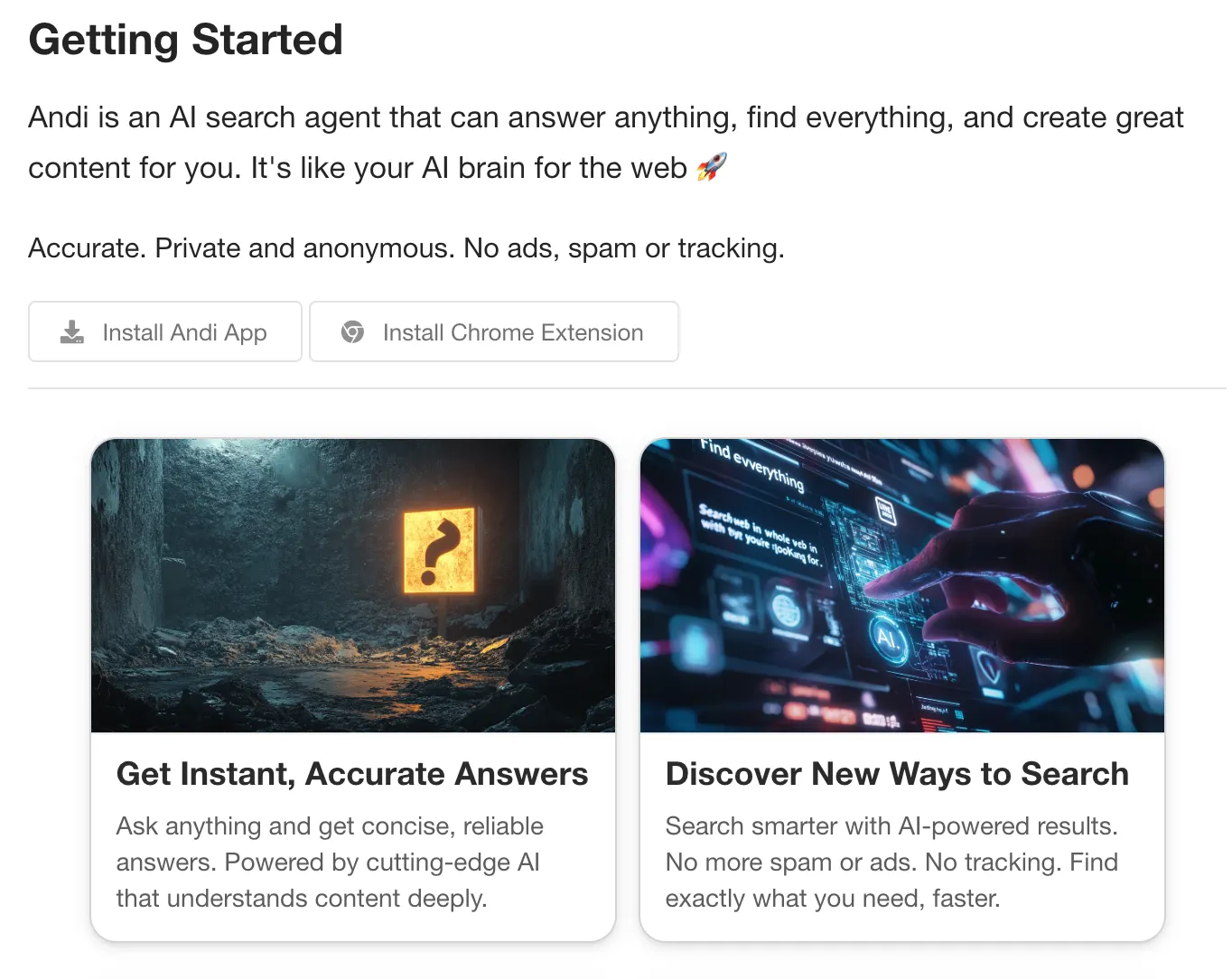
Andi is an AI-powered search engine designed to give users direct answers instead of making them sort through pages of traditional search results. It combines conversational search, web research, source-based answers, and AI-generated summaries in a cleaner interface than a typical search engine.
What makes Andi particularly interesting is that it was built as a search product from the ground up rather than simply adding a chatbot to an existing search engine. The company describes its technology as using its own AI search infrastructure to understand the meaning and relevance of web pages instead of relying only on traditional keyword matching.
For everyday users, the experience is straightforward: type a question in natural language, let Andi search the web, and read the synthesized answer alongside the underlying sources. It feels closer to asking a research assistant a question than entering keywords into a conventional search box.
🧭 How Andi Differs From Traditional Search
Traditional search engines are very good at finding pages. The problem is that finding the right page and getting the answer are not always the same thing.
Andi takes a different approach. Instead of simply returning a list of links, it attempts to understand what the user is asking, find relevant information, and organize that information into an answer.
This is particularly useful for questions that normally require several searches. For example, instead of searching separately for a product's specifications, reviews, alternatives, and pricing, a user can ask Andi to compare them in a single query.
The result is a search experience that puts the answer closer to the center of the interface while still allowing users to inspect the websites and sources behind the response.
🧠 How Andi's Search Technology Works
The technology behind Andi is one of the more important parts of the product. Andi says its search infrastructure, known as Trantora, is designed to index and understand large amounts of web content and evaluate information based on relevance and credibility.
Rather than treating a web page as a collection of keywords, the system attempts to understand the meaning of the content. This semantic approach is intended to make it easier to identify useful information even when the wording of the user's question does not exactly match the wording used on a web page.
Andi also operates its own search infrastructure rather than simply presenting another search engine's results with a chatbot interface. This gives the company more control over how information is retrieved, ranked, and presented to users.
✨ Main Features of Andi AI
1. AI-Generated Direct Answers
Andi can turn a natural-language question into a concise answer rather than forcing the user to open multiple search results and assemble the information manually.
This is particularly useful for factual questions, explanations, comparisons, research topics, and questions where the user already knows what they want but does not know which website contains the answer.
2. Conversational Search
Users can search using complete sentences rather than carefully constructed keywords. This makes the service approachable for people who are not experienced with advanced search operators.
For example, a user can ask:
"What are the main differences between OLED and Mini-LED monitors for a Mac user?"
That type of question is much closer to how people naturally think than a collection of disconnected search keywords.
3. Web-Based Research
Andi is designed around live web information rather than relying exclusively on a static language model. This makes it more suitable for research questions where current online information matters.
4. Source Discovery
Andi does not completely hide the web behind an AI-generated response. Search results and source information remain available so users can investigate the original material.
This is important because a useful AI search product should make it easy to check where an answer came from instead of asking users to trust generated text blindly.
5. Web Page Summarization
Andi can summarize longer web pages and articles, which is useful when a page contains valuable information but is difficult to scan quickly.
6. Semantic Search
Instead of depending only on exact keyword matches, Andi's search infrastructure is designed to understand concepts and relationships between pieces of information. This is one of the product's central technical ideas.
7. Privacy-Focused Search
Privacy is a major part of Andi's positioning. The company says it does not track or log users' searches and does not build advertising profiles from search behavior.
Andi also positions itself as an ad-free search experience, which gives the interface a noticeably different feel from traditional search engines dominated by advertising placements.
8. Mobile-Friendly Progressive Web App
Andi does not require a traditional mobile application. Its Progressive Web App can be added to a phone's home screen, allowing users to access the service in an app-like way without installing a conventional native application.
9. Chrome Extension
Andi also provides a Chrome extension that can make Andi the default search engine, allowing users to move from conventional browser search to AI-powered search without significantly changing their normal browsing habits.
🌎 Andi's Global Reach and Market Position
Andi was founded in the United States and was part of Y Combinator's Winter 2022 batch. The company publicly launched its search product in 2023 and has positioned itself as an independent alternative to larger search and AI platforms.
Andi has attracted an international audience because its basic proposition is not tied to one country. Users can search for technology, travel, products, news, research, and general topics using natural language.
Historical company materials have reported that more than one million people had used Andi. That figure should be treated as a historical milestone rather than a current active-user count, because user numbers change over time and Andi does not publish a reliable real-time global user figure.
From a competitive standpoint, Andi belongs to the broader AI-search category alongside products such as Perplexity and other answer-focused search engines. Its more distinctive characteristics are its independent search infrastructure, privacy positioning, lack of advertising, and emphasis on semantic understanding.
📊 Andi's Search Accuracy and Answer Quality
Search accuracy is one of Andi's central selling points. The company has published benchmark results showing strong performance on factual search tasks.
Benchmark numbers are useful for understanding how a product performs under a specific testing methodology, but they should not be interpreted as proof that Andi will outperform every competitor on every type of search.
In real-world use, search quality depends on the question, the availability of reliable sources, the freshness of the information, and the complexity of the task.
The more meaningful test is practical: does Andi find relevant sources, understand them correctly, answer the actual question, and make it easy to verify the result? Those are the areas where its AI-search approach is most useful.
🛠️ How to Use Andi AI
Step 1: Open Andi
Open Andi in a modern web browser. The consumer search product is web-based, so there is no traditional desktop software installation required.
Step 2: Enter a Natural-Language Question
Write your question in the same way you would ask another person. You do not need to reduce everything to keywords.
Example: "What are the best lightweight laptops for developers who travel frequently?"
Step 3: Review the Generated Answer
Andi will analyze the query and return an AI-generated response together with relevant search information.
Step 4: Check the Sources
Open the cited or recommended sources when the subject is important. This is particularly important for financial information, medical information, legal topics, technical specifications, and current events.
Step 5: Refine the Search
If the answer is too broad, add constraints. Specify a country, budget, date range, operating system, audience, or preferred technology to make the result more useful.
🎯 Practical Tips for Getting Better Results
Be Specific About What You Actually Need
"Best laptop" is a weak query because there is no single best laptop for everyone. A better query would be:
"What are the best Windows laptops under $1,500 for software development and frequent travel?"
Ask for Comparisons
Andi is useful when the information you need is spread across multiple websites. Instead of researching each option separately, ask it to compare the products or services based on specific criteria.
Add a Date When Freshness Matters
For pricing, software versions, product availability, company news, and current recommendations, include a date or time period in your question.
Ask for Sources
When doing serious research, inspect the sources provided by the search results. This turns Andi from a simple answer generator into a more useful research tool.
Use Follow-Up Questions
Do not expect the first query to produce the perfect answer. Start broad, identify the useful information, and then narrow the research with follow-up questions.
Don't Treat AI Answers as Final Authority
Andi's purpose is to make web research faster, not to eliminate the need for judgment. Important claims should still be checked against primary sources, especially when the cost of getting something wrong is high.
💻 Installation and Device Support
For normal users, Andi does not require conventional software installation. It can be used directly through a web browser.
On mobile devices, Andi can be installed as a Progressive Web App by using the browser's share menu and selecting the option to add the service to the home screen.
Desktop Chrome users can also install the Andi Chrome extension and configure Andi as their default search engine.
This approach is convenient because users can start using Andi without downloading a large desktop application or managing a separate software package.
💰 Is Andi Free?
Yes. Andi's consumer search service is currently available for free. The company has positioned its consumer search experience as a free, ad-free product rather than a traditional subscription search engine.
There is an important distinction between the consumer search product and Andi's developer API. The normal search experience is free, while the API is a separate commercial product designed for developers building AI agents, RAG systems, research applications, and search products.
💵 Andi AI Search API Pricing
Andi has expanded beyond consumer search with an AI Search API. The API provides programmatic access to Andi's search infrastructure and is designed for AI agents, RAG pipelines, search applications, and other software products.
Andi uses a usage-based pricing model for its API. The cost depends on how much search work is performed, with faster searches generally requiring fewer resources than deeper research-oriented searches.
The API also provides different search depths, allowing developers to choose between faster responses and more comprehensive research.
| Product | Pricing Model | Best For |
|---|---|---|
| Andi Search | Free | Everyday web search and AI-assisted research |
| Andi Search API | Usage-based | AI agents, RAG, applications, and developer projects |
| Fast Search | Usage-based | Low-latency real-time search |
| Deep Search | Usage-based | More comprehensive research and source discovery |
Because API pricing can change as the service develops, developers should check the current API pricing before building a production application around a specific cost assumption.
👨💻 Andi for Developers and AI Builders
Andi's developer offering is becoming an important part of the product. The Search API gives developers access to web-search infrastructure through a structured interface instead of requiring them to build their own crawler, index, ranking system, and search pipeline.
The API is designed for AI agents that need current web information, RAG systems that require external context, research applications, news monitoring, and products that need embedded search capabilities.
Andi also supports structured output intended for LLM consumption. This is useful because developers building AI applications generally need clean search results that can be passed directly into another model rather than a page designed primarily for human browsing.
The API supports different search modes, filtering options, structured responses, and content retrieval features that can be used as building blocks for AI applications.
🔌 Andi API and AI Agent Integration
For developers, one of Andi's more interesting features is its focus on AI agents. The API can provide web search results to an agent that needs current information while completing a task.
Andi also provides an MCP server that can connect its search and web-fetching capabilities to development environments and AI tools. This makes the service relevant not only as a consumer search engine but also as infrastructure for applications that need real-time web access.
For a developer building an AI research assistant, the workflow could look like this:
- The user asks a research question.
- The AI agent determines that current web information is required.
- The agent sends the query to Andi.
- Andi searches its web index.
- The relevant results and content are returned in structured form.
- The language model uses those sources to produce the final response.
👥 Who Should Use Andi?
Students
Andi can help students quickly understand unfamiliar topics, summarize reading material, compare sources, and start research.
Researchers and Knowledge Workers
People who spend a lot of time researching online can benefit from having search results synthesized into a readable answer before opening individual sources.
Developers
Developers can use Andi to investigate technologies, search technical information, compare frameworks, and find relevant documentation.
Content Professionals
Writers, editors, marketers, and analysts can use Andi as a starting point for research, particularly when they need to collect information from several websites.
Everyday Search Users
Andi is also suitable for people who find conventional search results too cluttered and would rather receive a direct explanation before opening individual pages.
⚠️ Common Problems When Using Andi
AI Answers Can Still Be Wrong
Even when search results are grounded in web sources, the final answer is generated and interpreted by AI. A correct source can still lead to an incomplete or misleading summary.
Search Results Depend on Available Web Information
If reliable information is not publicly available, Andi cannot create authoritative evidence out of nothing. Niche topics with limited online coverage may produce weaker results.
Conflicting Sources Can Cause Confusion
When different websites disagree, the best approach is to inspect the original sources rather than assuming the AI has automatically identified the correct position.
Current Information Changes Quickly
Prices, product specifications, software versions, company policies, and regulations can change. When the information matters, verify the date and source before acting on it.
Search and Research Are Not the Same Thing
A short factual question may only require one search. A serious research project may require multiple searches, primary-source verification, and independent judgment. Andi can accelerate that process, but it does not remove those steps.
🔐 Privacy and Advertising
Privacy is one of Andi's clearest product differentiators. The company says that it does not log or track users' searches and positions the consumer search product as ad-free.
This is particularly appealing for users who dislike search engines that personalize results based on extensive behavioral profiles. Andi's privacy-first positioning is part of the company's broader argument that search can be useful without turning every query into an advertising signal.
Users should still avoid entering highly sensitive personal information into any online AI service. Privacy claims are useful, but they should not be treated as a reason to paste passwords, private documents, API keys, or confidential business information into a search box.
⚖️ Andi AI: Strengths and Weaknesses
| Strengths | Weaknesses |
|---|---|
| Free consumer search | Smaller ecosystem than major search platforms |
| Direct AI-generated answers | AI answers still require verification |
| Ad-free experience | Some complex research tasks still require multiple searches |
| Privacy-focused positioning | Search quality varies depending on available web sources |
| Independent search infrastructure | Less familiar to mainstream users than Google |
| Source-based research | Not a replacement for authoritative primary sources |
| Chrome extension and PWA support | Some advanced developer features require the separate API |
| Developer API and AI-agent support | API usage is billed separately from consumer search |
❓ Frequently Asked Questions About Andi
Is Andi AI free?
Yes. The consumer version of Andi is currently available for free and is designed for normal everyday searching without requiring a paid subscription.
Do I need an account to use Andi?
Andi's consumer search experience is designed to be accessible without a traditional account requirement, making it possible to start searching without going through a lengthy registration process.
Does Andi have a mobile app?
Andi can be used as a Progressive Web App, allowing users to add it to their mobile home screen and use it in an app-like format without installing a conventional native application.
Does Andi have a Chrome extension?
Yes. Andi provides a Chrome extension that can be used to make Andi the default search engine.
Is Andi better than Google?
There is no universal answer. Andi can be more convenient when the user wants a synthesized explanation instead of a list of links. Google remains extremely strong for navigation, local search, shopping, maps, established websites, and many specialized searches.
Is Andi similar to Perplexity?
They belong to the same broad AI-search category because both combine web search with AI-generated answers. Andi differentiates itself through its own search infrastructure, privacy positioning, ad-free experience, and semantic indexing approach.
Does Andi have an API?
Yes. Andi offers a Search API designed for AI agents, RAG pipelines, research applications, and embedded search. It provides structured results and different search modes.
How many pages does Andi index?
Andi has stated that its search infrastructure indexes more than 25 billion web pages. The exact size of the index can change over time.
Can Andi summarize web pages?
Yes. Summarization is one of the consumer product's useful functions and can help users extract important information from longer web pages more quickly.
Can I trust everything Andi tells me?
No. Andi is a research assistant, not an infallible authority. For important decisions, check the original sources and give priority to official documentation, government information, academic publications, or primary sources where appropriate.
📋 Andi AI at a Glance
| Product | Andi AI |
|---|---|
| Category | AI Search Engine |
| Founded | 2021 |
| Public Launch | 2023 |
| Company | Andi AI |
| Headquarters | United States |
| Core Technology | Trantora AI Search Infrastructure |
| Consumer Search | Free |
| Advertising | Ad-free consumer experience |
| Privacy Position | No search tracking or profiling according to Andi |
| Mobile Access | Progressive Web App |
| Browser Extension | Chrome extension available |
| Developer API | Yes |
| API Pricing | Usage-based |
| Indexed Pages | 25 billion+ according to Andi |
🏁 Final Review: Is Andi Worth Trying?
Andi is worth trying if what you want from search is a useful answer first and a collection of links second. Its interface is simple, the consumer product is free, and the combination of AI answers, web search, source discovery, privacy, and an ad-free experience makes it noticeably different from conventional search.
The most interesting part of Andi is not simply the chatbot interface. The company is trying to build its own search infrastructure around semantic understanding, source quality, and AI-native retrieval. That gives the product a more ambitious technical foundation than a simple chatbot layered over a conventional search engine.
For casual searches, Andi is easy to use. For research, it becomes more useful when you give it specific questions, clear constraints, and follow-up requests. For developers, the separate API makes Andi even more interesting because its search infrastructure can be incorporated into AI agents and RAG applications.
It is not a replacement for every search engine. Google remains better for many navigational and local tasks, while specialized tools can be better for shopping, maps, academic research, or highly technical databases. But for people who regularly ask questions that require reading and combining information from several web pages, Andi offers a genuinely useful alternative.
Overall assessment: Andi is one of the more interesting independent AI search products, particularly because it combines a free consumer search experience with its own search infrastructure, privacy-first positioning, and a developer API. Its biggest advantage is not that it makes search look like a chatbot; it is that it is trying to rethink how search retrieves and presents information in the first place.
Comments