

🧩 What Is Base44?
Base44 is an AI-powered app development platform that turns plain-language instructions into functional software. Instead of starting with a blank code editor, database schema, authentication system, hosting setup, and deployment pipeline, you describe the product you want and Base44 helps build the application for you.
Base44 was founded by Maor Shlomo and launched in 2025. The product was built around a straightforward idea: many people have useful software ideas but lack the time, technical skills, or budget to turn those ideas into working applications.
In June 2025, Wix acquired Base44 for approximately $80 million in initial consideration, with additional performance-based payments. Base44 continues to operate as a distinct product within the Wix ecosystem.
The platform is positioned beyond a traditional AI website builder. Base44 is designed for creating full applications that can include user interfaces, databases, authentication, permissions, business logic, integrations, AI features, hosting, and deployment.
In practical terms, Base44 tries to shorten the distance between “I have an idea” and “I have a working application.” That makes it particularly interesting for startup founders, small businesses, product managers, marketers, designers, internal teams, and developers who want to move quickly from an idea to a usable product.
It is also important to understand what Base44 is not. It is not simply a chatbot that writes isolated pieces of code. The platform is designed to handle much of the surrounding application infrastructure as well, including data, authentication, business logic, integrations, and deployment.
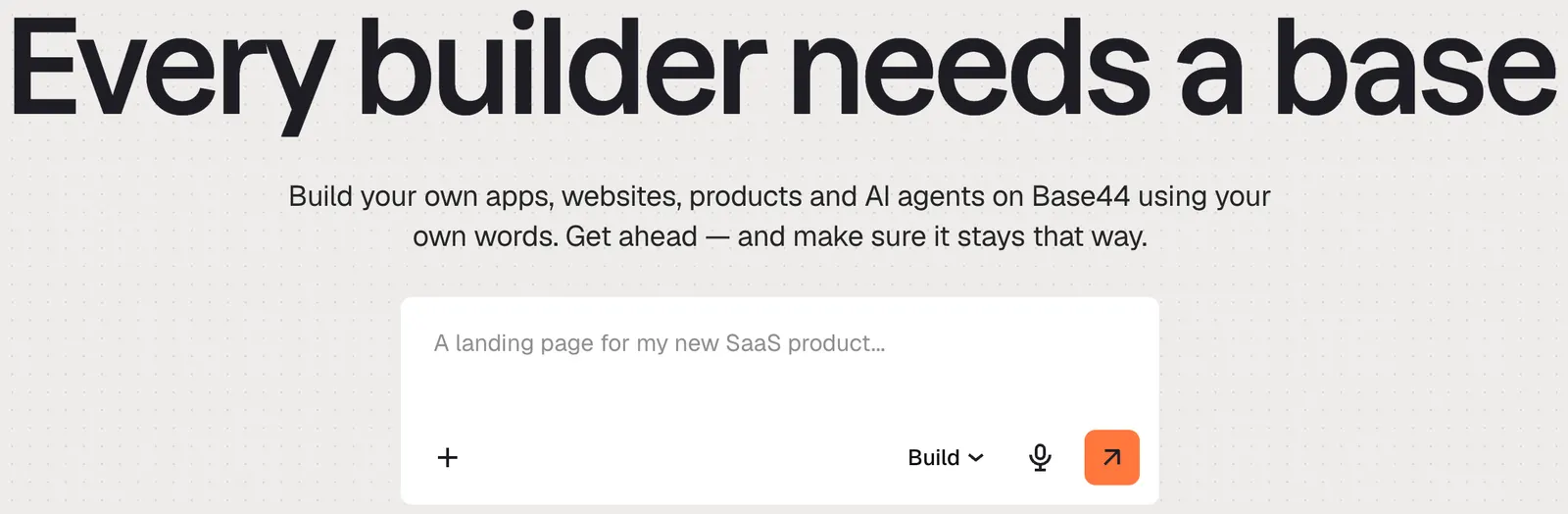
⚙️ Core Features of Base44
1. Natural-Language App Building
The main Base44 experience is conversational app development. You describe what you want to build in normal language, and the AI translates that description into an actual application.
For example, instead of manually writing a technical specification, you could say:
“Build an employee expense tracker where employees can submit expenses, managers can approve or reject them, and finance can view monthly spending by department.”
Base44 can use that description to create the screens, data structure, workflows, and application logic needed for the initial version.
2. Full-Stack Application Generation
One of Base44's main strengths is that it goes beyond generating a front-end interface. The platform can create application logic, databases, authentication, permissions, and backend functionality.
This distinction matters. Creating a dashboard that looks convincing is relatively easy. Creating a dashboard that stores users, saves records, applies permissions, processes actions, and maintains application state is a much larger development task.
3. Database and Authentication
Base44 provides database and authentication capabilities as part of its application-building environment. This means you do not necessarily need to configure a separate database or authentication provider just to build a basic SaaS product, customer portal, internal dashboard, or membership application.
You can describe the information your application needs to store and the types of users who need access, then refine the resulting structure through additional instructions.
4. AI-Powered Iteration
Base44 is designed for iterative development rather than one-shot generation. Once the first version exists, you can continue asking the AI to modify the application.
For example:
- “Add a search field to the customer table.”
- “Only administrators should see this page.”
- “Add an approval status to every expense.”
- “Make the dashboard easier to use on mobile.”
- “Send an email notification when an order is approved.”
This conversational development model makes Base44 feel closer to working with an AI development assistant than configuring a traditional no-code platform manually.
5. Integrations and APIs
Base44 can connect applications with external services and business tools. Depending on the project and plan, users can work with integrations involving services such as HubSpot, Google Drive, Salesforce, Slack, Notion, and other external systems.
API-based integrations can also be used for more customized workflows.
This matters for real businesses because most applications do not operate independently. A sales dashboard may need CRM data. A customer portal may need email notifications. An order system may need payment processing. An internal dashboard may need information from several existing services.
6. GitHub Integration and Code Access
Base44 supports GitHub integration on eligible paid plans. Users can work with their application source code through GitHub and move toward a more conventional development workflow when required.
This is useful for developers who want the speed of AI-generated application scaffolding without permanently giving up access to the underlying project.
7. Hosting and Custom Domains
Base44 provides hosting and allows applications to be published from the platform. Paid plans add custom-domain capabilities.
For small projects, this can eliminate a lot of infrastructure work. You do not necessarily need to separately configure a frontend host, backend server, database, and authentication system just to put a working application online.
8. AI Superagents
Base44 has also expanded into AI agents through its Superagents feature. These agents can perform tasks, react to triggers, execute workflows, interact with connected services, and perform scheduled work.
Superagents can extend the platform beyond application creation into AI-powered business automation. This is an important direction for Base44 because it means the platform is increasingly about both building software and giving that software autonomous capabilities.
✨ What Makes Base44 Different?
It Handles More Than the Interface
Many AI development products are very good at generating a front-end prototype. The real difficulty starts when the application needs users, persistent data, permissions, workflows, integrations, and business rules.
Base44 puts many of those components inside the same creation environment. That makes it more suitable for functional business applications than tools focused primarily on generating visual interfaces.
It Is Built Around Vibe Coding
Base44 is part of the growing vibe coding movement, where users describe the desired software in natural language and AI handles a large portion of the implementation.
The practical appeal is that you can participate in application development without first becoming an expert in every underlying technology.
It Creates Working Applications, Not Just Mockups
A generated landing page can look impressive while doing almost nothing.
Base44 is designed for applications that actually need to perform tasks. That can include customer portals, booking systems, inventory trackers, approval systems, CRM tools, dashboards, project-management applications, and internal business software.
Strong Fit for Internal Business Tools
This is one of Base44's most practical use cases.
A company might need a custom approval dashboard or inventory system, but the project may be too specialized for an off-the-shelf product and too small to justify a long engineering project.
Base44 sits in that middle ground.
Backed by Wix
Wix's acquisition gives Base44 access to the resources, infrastructure, and distribution capabilities of a much larger technology company.
For users, this is relevant because Base44 is no longer operating purely as a small independent startup. Its development is now connected to Wix's broader strategy around AI-powered software creation.
💼 Practical Use Cases for Base44
Business Applications
Base44 can be used to create customer portals, inventory systems, employee dashboards, quotation tools, approval workflows, project trackers, and other custom business applications.
Marketing
Marketing teams can build campaign dashboards, lead-management systems, content workflows, influencer databases, SEO utilities, campaign approval tools, and internal reporting applications.
Sales
Sales teams can create lead trackers, pipeline dashboards, commission calculators, proposal tools, territory-management systems, and custom customer portals.
Operations
Operations teams can build inventory trackers, vendor-management systems, inspection forms, scheduling tools, task dashboards, and reporting applications.
Customer Portals
Businesses can create portals where customers log in, review project progress, upload documents, submit requests, communicate with staff, or access account information.
Education
Teachers, schools, and independent educators can create quizzes, student dashboards, learning applications, training tools, course-management systems, and simple educational platforms.
Startup MVPs
For startup founders, Base44 can be useful during the validation stage. Instead of spending months building a complete production system before speaking to customers, a founder can create a functional MVP, test it with users, and learn which features actually matter.
Personal Tools
Base44 does not have to be used for a business. It can also create personal finance trackers, travel planners, collection databases, event organizers, hobby-management tools, calculators, and other small applications that would otherwise require custom development.
🛠️ How to Use Base44
Step 1: Create an Account
Start by creating a Base44 account. The platform offers a free plan, so you can test the core experience before committing to a paid subscription.
Step 2: Define the Problem
Before writing your first prompt, decide what problem the application should solve.
A weak request would be:
“Build me a business application.”
A much better request would be:
“Build an internal equipment checkout system for a 30-person video production company. Employees can request equipment, managers can approve requests, and the operations team can see which items are checked out and when they are due back.”
The second description gives Base44 a clear user group, workflow, data structure, and business objective.
Step 3: Generate the Initial Application
Enter your requirements into the Base44 builder. The AI will create the initial application structure and provide a working version that you can preview.
Step 4: Test the Main Workflow
Do not immediately add twenty extra features. First confirm that the core workflow works.
For an equipment application, test creating an employee request, approving it as a manager, checking out the equipment, and recording the return date.
Step 5: Fix Problems With Specific Instructions
When something does not work, describe the exact behavior and the expected result.
For example:
“When a manager approves an equipment request, the request status changes to Approved, but the equipment inventory remains Available. Change the inventory status to Checked Out and display the expected return date.”
This is far more useful than simply saying “fix the inventory.”
Step 6: Improve the Interface
Once the core functionality works, refine navigation, tables, forms, dashboards, spacing, typography, colors, and mobile layouts.
Step 7: Add Integrations
After the basic application is stable, connect external services such as email, CRM platforms, payment systems, or automation tools.
Step 8: Configure User Roles
Define exactly what each type of user can view and modify. For example, employees may create requests, managers may approve them, and administrators may manage inventory and users.
Step 9: Test Before Publishing
Use multiple accounts and realistic data to test authentication, permissions, database operations, forms, mobile layouts, notifications, and error states.
Step 10: Publish
When the application is ready, publish it through Base44 and share it with your intended users. Custom domains are available on paid plans.
🧠 Base44 Prompting Tips
Describe the User First
Instead of saying “Create a dashboard,” explain who will use it and what information they need.
“Create a dashboard for a sales manager who needs to see open opportunities, overdue follow-ups, conversion rates, and revenue by salesperson.”
This gives the AI a much clearer product direction.
Describe Workflows Instead of Just Pages
Explain what should happen after an action.
“When a customer submits a support request, create a ticket, assign it to the support queue, send a confirmation email, and show the ticket in the administrator dashboard.”
This is much more useful than asking for a generic support page.
Build in Stages
A common mistake is trying to create an entire SaaS product in one enormous prompt. A staged approach is easier to test and troubleshoot.
- Create the basic data structure.
- Build the primary user workflow.
- Test it.
- Add authentication.
- Add secondary features.
- Connect external services.
- Improve the interface.
Tell Base44 What Should Stay Untouched
This becomes increasingly important as the application grows.
Instead of saying:
“Redesign the dashboard.”
Try:
“Improve the dashboard layout without changing the database structure, navigation labels, user permissions, or existing filtering behavior.”
Clear boundaries can reduce unnecessary changes to features that already work.
Use Real Examples
If you are creating a CRM, provide example customers. If you are building an inventory system, provide example products. If you are designing an approval workflow, describe a realistic approval scenario.
Concrete examples give the AI more useful context than abstract descriptions.
Test After Major Changes
After adding an important feature, test the entire workflow again. AI-generated software can introduce unexpected changes elsewhere, particularly when several features depend on the same data.
💻 Installation and Access
Web
The main Base44 experience is web-based. You can create, edit, test, and publish applications from a modern desktop browser without installing a traditional development environment.
Windows
Windows users can access Base44 through a modern browser. A separate Windows development application is not required for the core builder.
Mac
Mac users can also work through the browser. You do not need to install Node.js, a database server, or a separate hosting environment just to begin building a Base44 application.
iPhone and iPad
Base44 has a mobile application for iPhone and iPad, allowing users to interact with the Base44 platform from mobile devices.
Android
Base44 applications are web-based and responsive, so they can be accessed from Android devices through a mobile browser. Depending on the application, users can also use a progressive-web-app style experience.
Native Mobile Applications
A standard Base44 project should not automatically be treated as a native iOS or Android application. Web deployment is the simpler and more immediate route. Projects that require app-store distribution involve additional packaging and publishing considerations.
Browser Extension
A browser extension is not required. The main Base44 development environment runs through the web.
💰 Base44 Pricing
Base44 uses a credit-based pricing system. This is one of the most important things to understand before starting a large project because AI conversations, integrations, and other operations consume credits.
Free — $0/month
The Free plan provides access to the basic Base44 experience and currently includes a limited monthly allocation of message and integration credits.
It is useful for experimenting with the builder, creating small projects, and determining whether the workflow suits your needs.
Starter — approximately $16/month when billed annually
The Starter tier increases the available monthly credits and adds capabilities intended for people who are building more regularly. Features include additional application capacity and custom-domain functionality.
Builder — approximately $40/month when billed annually
The Builder plan provides a larger credit allocation and is designed for users who are developing more actively and need greater capacity.
Pro — approximately $80/month when billed annually
The Pro plan provides a significantly larger credit allowance and adds advanced features such as AI model selection, GitHub integration, in-app code editing, and additional development capabilities.
Elite — approximately $160/month when billed annually
The Elite tier provides a much larger monthly credit allocation and is intended for heavy users who are building and iterating on applications frequently.
Enterprise
Enterprise pricing is customized rather than presented as a standard individual subscription. Enterprise environments can include organization-level controls, identity management, permissions, auditing, data controls, shared credit pools, and dedicated support.
Base44's pricing structure can change as the platform evolves, so businesses should verify the current credit allocations and plan features before subscribing.
The key pricing question is therefore not simply “How much does Base44 cost?” but “How much AI development and integration work will my application require each month?”
👥 Who Should Use Base44?
Startup Founders
Founders can use Base44 to build and test an MVP before committing substantial engineering resources.
Small Businesses
Small businesses are one of the clearest target groups. They often have software requirements that are too specific for off-the-shelf tools but too small to justify hiring a development team for months.
Product Managers
Product managers can create functional prototypes instead of relying entirely on static product mockups. This makes it easier to test actual workflows with stakeholders.
Developers
Developers can use Base44 as an acceleration tool rather than a replacement for programming. It can help with application scaffolding, prototypes, internal tools, and early versions of products before developers take over the parts that require deeper technical control.
Designers
Designers can use Base44 to move from visual concepts toward interactive applications that stakeholders can actually test.
Marketing Teams
Marketing professionals can build campaign management tools, lead trackers, content workflows, SEO utilities, customer-facing applications, and internal dashboards.
Students
Students can use Base44 to turn software concepts into working projects while learning how databases, authentication, APIs, user flows, and application logic fit together.
Non-Technical Users
People without programming experience can use Base44 to build custom software for problems that would otherwise require a developer.
🌎 Global Usage and Market Reach
Base44 has grown rapidly since launching in 2025. Wix reported that Base44 had reached approximately $100 million in annual recurring revenue by early 2026, making it one of the more notable examples of rapid growth in the AI software-building market.
Base44 also describes its community as consisting of millions of builders. However, the company does not provide a continuously updated public breakdown of active users by individual country.
Third-party web-traffic estimates indicate that the United States is one of Base44's largest markets, with substantial traffic also coming from countries including India, Brazil, the United Kingdom, and other international markets.
These traffic estimates should be treated as directional rather than audited customer numbers. Website visits, registered accounts, active users, and applications created are different metrics.
What is easier to establish is that Base44 has moved well beyond the experimental stage. Its acquisition by Wix, rapid revenue growth, large builder community, and international web traffic all point to a product with significant global adoption.
⚖️ Base44 Pros and Cons
Pros
- Fast development: Base44 can turn a clear software idea into a usable first version much faster than traditional development.
- Full-stack capabilities: The platform handles more than visual interfaces, including databases, authentication, business logic, and integrations.
- Accessible to non-developers: Users can describe workflows in normal language instead of starting with programming syntax.
- Strong business use cases: Internal dashboards, customer portals, approval systems, trackers, and MVPs are natural applications for the platform.
- Code access: GitHub integration provides a path toward conventional software development for teams that need more control.
Cons
- Credits can become expensive: Heavy AI usage can consume credits quickly, especially during repeated development iterations.
- Generated applications still require testing: AI can produce functional-looking software with logical errors, permission problems, or edge cases.
- Less low-level control: Developers who require complete control over infrastructure and architecture may eventually find the platform restrictive.
- Native mobile development is not the same as web deployment: A responsive web application is easy to access on phones, but app-store distribution introduces additional requirements.
🔍 Base44 vs. Similar AI App-Building Tools
Base44 competes with several different categories of tools, including AI coding environments, AI website builders, visual no-code platforms, and conversational application builders.
| Tool | Main Focus | Typical Users | Pricing Model | Key Difference |
|---|---|---|---|---|
| Base44 | Full-stack AI application building | Businesses, founders, teams, developers | Free + credit-based plans | Combines frontend, backend, database, authentication, integrations, hosting, and AI workflows. |
| Lovable | AI-assisted web application development | Founders, designers, developers | Free + paid plans | Strong conversational product-building workflow with a developer-friendly approach. |
| Bolt | AI coding and web development | Developers and technical creators | Free + paid plans | Places more emphasis on browser-based coding and direct code generation. |
| Replit | Cloud development with AI | Developers, students, teams | Free + paid plans | Combines AI coding with a broader cloud development environment. |
| v0 | AI-generated interfaces and web applications | Developers and designers | Free + paid plans | Particularly strong for generating modern web interfaces and frontend experiences. |
| Bubble | Visual no-code applications | Businesses and no-code builders | Free + paid plans | Offers extensive visual configuration and mature no-code controls. |
Base44 vs. Lovable
Base44 and Lovable are close competitors because both allow users to describe applications conversationally and then iterate with AI.
Base44 places considerable emphasis on providing the surrounding application infrastructure, while Lovable is particularly appealing to users who want an AI-first development workflow that remains close to a modern software-development stack.
Base44 vs. Bolt
Bolt is attractive to users who want AI-assisted coding inside a browser-based development environment. Base44 is more opinionated about the infrastructure and services surrounding the application.
If you want the platform to handle more of the application setup, Base44 is appealing. If you want to work directly with the generated development environment and code, Bolt may feel more natural.
Base44 vs. Replit
Replit is broader as a cloud development platform and remains a natural choice for people who want a coding workspace combined with AI assistance.
Base44 is more focused on reducing how much traditional development work is required to get a functional application running.
Base44 vs. Bubble
Bubble is a mature no-code platform that gives users extensive visual control. Base44 takes a much more AI-driven approach.
Bubble can be attractive when you want to manually construct and tune application behavior. Base44 is more appealing when you prefer to describe the desired behavior and let AI generate the initial implementation.
🚀 A Practical Base44 Project Example
Imagine that a small consulting company wants a client portal.
A useful first prompt could be:
“Create a client portal for a consulting company. Clients can log in, see active projects, view project milestones, upload documents, submit questions, and see upcoming meetings. Consultants can manage projects, update milestones, respond to questions, and review uploaded documents.”
After Base44 creates the first version, the team could improve it in smaller steps:
- Add separate client and consultant roles.
- Create project and milestone records.
- Add document uploads.
- Add a customer-question workflow.
- Add email notifications.
- Improve the dashboard layout.
- Make the interface responsive on mobile.
- Connect the company's existing tools.
- Test permissions with different accounts.
- Publish the portal.
This is where Base44 becomes more interesting than a simple AI code generator. The user is not asking AI to write one isolated function. They are using AI throughout the application-building process.
The human still decides what the product should do. Base44 handles a significant portion of the implementation work.
📊 Where Base44 Works Best
Base44 is particularly useful when the problem is software assembly.
You understand the business problem. You know the workflow. The project needs screens, forms, users, data, permissions, dashboards, and perhaps several integrations. The challenge is that building all those components manually would take more time than the business problem justifies.
That is the sweet spot for Base44.
The situation changes when an application requires unusual infrastructure, highly specialized performance, complicated distributed systems, advanced native mobile behavior, or complete control over every dependency.
In those cases, conventional development may still be more appropriate.
There is another practical consideration: the more important the application data is, the more seriously you should approach security, permissions, backups, testing, and data ownership. AI can make software development faster, but it does not remove the responsibility of operating software safely.
🏁 Final Verdict: Is Base44 Worth Using?
Base44 is a strong option for people who want to build functional software without starting with a traditional development project.
Its strongest use case is the person or team that has a clear business problem but does not want to spend weeks assembling the technical infrastructure needed to solve it.
If you need a customer portal, internal dashboard, approval system, inventory tool, CRM extension, project tracker, booking system, or startup MVP, Base44 can significantly shorten the path from idea to working product.
It can also be valuable for developers. The most realistic benefit is not “developers will never need to code again.” A better way to look at it is that Base44 can accelerate the first stage of application development, allowing developers to spend more time on the parts that require deeper technical judgment.
The free plan makes it relatively easy to test the platform, while paid plans provide more credits and advanced capabilities. The main thing to watch is credit consumption, particularly if you expect to make many rounds of AI-generated changes.
Base44 is a good fit when:
- You have a clear application idea but limited development resources.
- You need a custom internal business tool quickly.
- You want to validate a startup idea before investing heavily in engineering.
- You want to turn an existing business workflow into software.
- You are a developer looking to accelerate application scaffolding and prototyping.
It may not be the right choice when:
- Your project requires complete low-level control over the technology stack.
- You are building highly specialized or performance-critical infrastructure.
- Your company already has a mature engineering team and tightly controlled development architecture.
- You need complex native mobile functionality that goes far beyond a responsive web application.
The most useful way to evaluate Base44 is not to ask whether it can replace professional software development everywhere. It cannot, and that is not really the point.
The better question is whether a particular application needs a traditional development process from day one.
For many small business tools, MVPs, internal systems, customer portals, workflow applications, and early-stage products, Base44 can remove a surprising amount of technical friction.
Base44's real value is simple: it lets people start with the problem they want to solve instead of starting with the technology they need to learn.
Comments