

🧠 Baseten: AI Infrastructure for Fast, Scalable Model Inference
Baseten is an AI infrastructure platform built for companies that need to run machine learning and generative AI models reliably in production. Instead of being a consumer chatbot like ChatGPT or Claude, Baseten gives developers the infrastructure, tooling, and APIs needed to deploy, optimize, scale, and monitor AI models behind real products.
That distinction is important. Baseten is not primarily something you open when you want to write an email or generate an image. It is the infrastructure layer that can sit behind an AI application, handling the difficult parts of model serving, GPU infrastructure, inference performance, autoscaling, deployment, and production operations.
For an AI startup moving from a prototype to thousands or millions of production requests, this is where Baseten becomes particularly interesting.
🏢 1. What Is Baseten?
Baseten is an AI infrastructure company founded in 2019 by Tuhin Srivastava, Amir Haghighat, Phil Howes, and Pankaj Gupta. The founders originally set out to solve a familiar machine learning problem: teams could build impressive models, but getting those models running reliably in production often required a large amount of custom infrastructure work.
Baseten was created around that problem. The company initially focused on helping machine learning teams move models from development into production. As generative AI became a much larger part of software development, Baseten shifted its focus toward high-performance inference for modern AI applications.
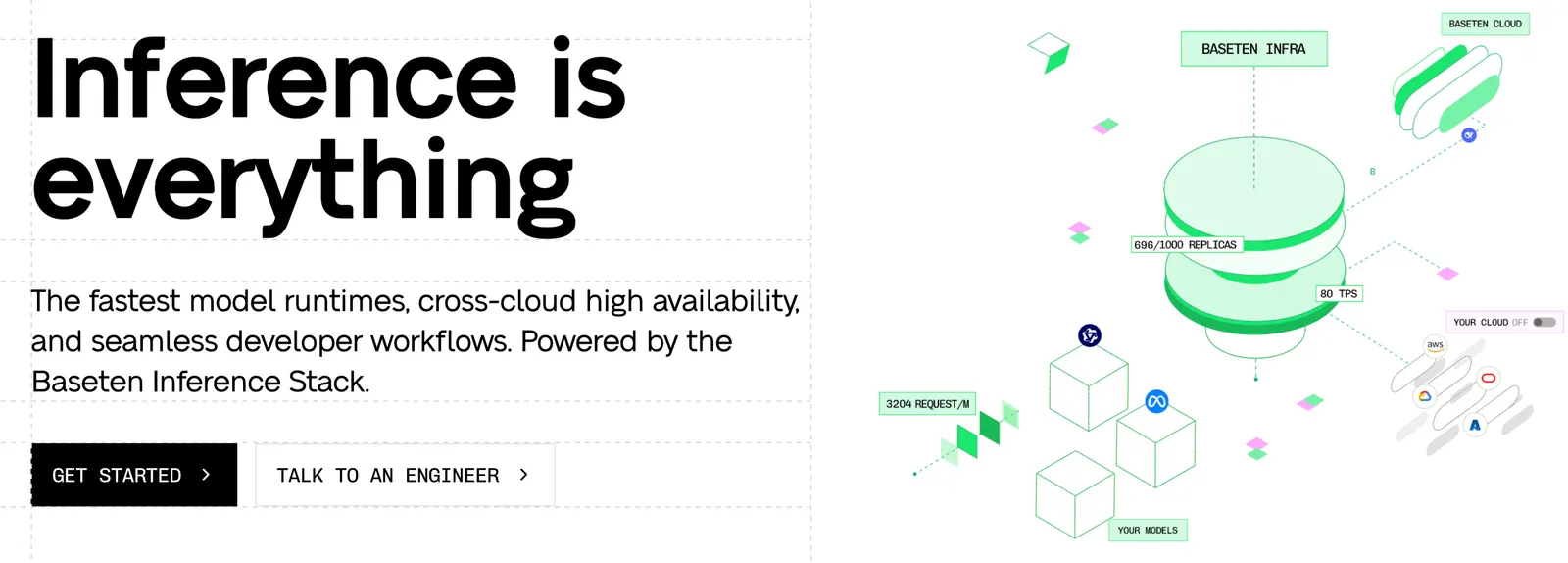
Today, Baseten describes itself as an inference platform for mission-critical AI workloads. Its platform supports open-source, fine-tuned, and custom models, while providing infrastructure for inference, training, deployment, scaling, and monitoring.
The company's central goal is relatively easy to understand: make it easier for developers to turn an AI model into a fast, reliable production service without having to build the entire GPU serving infrastructure themselves.
Baseten was founded in 2019, and its current product strategy is heavily centered on production inference, performance, infrastructure, and developer tooling. :contentReference[oaicite:0]{index=0}
⚙️ 2. Core Features
🚀 Production Model Deployment
Baseten allows developers to deploy open-source, fine-tuned, and custom AI models as production endpoints. Instead of manually configuring GPU servers, containers, networking, scaling policies, and model-serving infrastructure, developers can package their model and deploy it through Baseten.
🧩 Truss for Model Packaging
Truss is one of the most important pieces of the Baseten ecosystem. It is an open-source framework for packaging and serving machine learning models.
Developers can use Truss to define the model environment, dependencies, runtime configuration, and serving behavior before deploying the model to Baseten. It provides a more consistent path from a local model to a production endpoint.
🔌 Pre-Optimized Model APIs
Baseten also provides ready-to-use Model APIs for selected AI models. This means developers do not always need to deploy and maintain a model themselves. They can access an optimized model through an API and integrate it into their own software.
The available catalog changes over time and includes models for areas such as large language models, multimodal AI, speech, embeddings, and other generative AI workloads.
📈 Autoscaling
AI traffic is rarely perfectly predictable. An application may receive almost no requests at night and suddenly experience a large traffic spike during the day.
Baseten provides autoscaling capabilities that allow compute resources to respond to workload changes. This can be especially useful for startups that do not want to permanently reserve maximum GPU capacity.
⚡ Inference Optimization
Baseten's major technical focus is inference performance. Its inference stack includes runtime optimizations, custom kernels, caching techniques, continuous batching, request prioritization, quantization options, and other techniques designed to improve latency, throughput, and GPU utilization.
📊 Monitoring and Observability
Running a model in production requires more than making an API call. Developers need to understand latency, failures, request behavior, resource consumption, and deployment performance.
Baseten provides logging and observability tools designed specifically around production AI workloads.
🧪 Training and Fine-Tuning
Baseten has expanded beyond inference into model training and post-training workflows. Teams can use its infrastructure for training or customizing models and then move those models into production inference on the same platform.
🔗 Chains for Compound AI Workflows
Baseten Chains is designed for applications where one AI workflow contains multiple components or model calls. Instead of treating every model as an isolated endpoint, developers can coordinate several inference steps and allocate CPU and GPU resources more efficiently.
These features make Baseten much closer to an AI infrastructure platform than a conventional AI application. :contentReference[oaicite:1]{index=1}
⭐ 3. What Makes Baseten Different?
🏗️ Designed for Production From the Start
There are plenty of tools that make it easy to run an AI model for a quick demo. Baseten is aimed at the harder stage that comes afterward: running the model reliably for actual customers.
Latency, GPU utilization, autoscaling, deployment reliability, monitoring, and operational control are therefore central parts of the product rather than secondary features.
🔓 Strong Support for Open and Custom Models
Baseten does not force developers into one proprietary model ecosystem. Teams can work with open-source, fine-tuned, and custom models.
This is useful for companies that want more control over model weights, fine-tuning, inference configuration, or the overall AI stack.
⚡ Performance Is a Product Feature
For an AI application, model quality is only part of the user experience. If every response takes several seconds longer than expected, users notice.
Baseten invests heavily in inference optimization, including runtime improvements, caching, batching, hardware optimization, and other techniques intended to reduce latency and increase throughput.
☁️ Multi-Cloud Infrastructure
Baseten's infrastructure strategy is not limited to simply renting a GPU and handing developers an API endpoint. The company focuses on deploying inference workloads across cloud infrastructure and regions, with options that can also fit enterprise and hybrid environments.
👨🔧 Engineering Support
One notable difference is the emphasis on hands-on engineering support. For larger customers, Baseten provides forward-deployed engineers who can work with teams on model optimization and production performance.
Baseten's own product materials describe its platform around four areas: performance, infrastructure, developer tooling, and applied engineering expertise. :contentReference[oaicite:2]{index=2}
💼 4. Practical Use Cases
🤖 AI SaaS Applications
A startup building an AI writing platform, research assistant, document analyzer, coding assistant, or customer-support application can use Baseten to host the models powering its product.
💬 AI Agents
AI agents can make many model calls during a single task. When an application depends on fast responses and consistent infrastructure, inference performance becomes an important part of the overall product experience.
👨💻 Coding Tools
Companies building coding assistants can deploy open-source coding models and expose them through APIs. This provides more control over model selection than simply relying on a single closed AI provider.
🎨 Image Generation
Baseten can also be used for image-generation workloads, including custom models and workflows. This is useful for companies building their own image-generation products instead of sending every request to a consumer-facing image service.
🎙️ Speech and Audio Applications
Speech-to-text, text-to-speech, voice agents, transcription, and related applications can benefit from low-latency inference infrastructure.
📚 Document and Knowledge Processing
Companies can deploy models for document extraction, classification, summarization, search, embeddings, and other enterprise knowledge workflows.
🏢 Enterprise AI
Large organizations can use Baseten for internal AI services where security, data residency, access control, predictable performance, and production monitoring matter.
🧪 Research-to-Production Workflows
Research teams can use Baseten to move a model beyond a notebook or local GPU and turn it into an API that can be tested by an actual application.
The common thread is simple: Baseten makes the most sense when the AI model is part of a software product, rather than when the user simply wants to interact with an AI assistant.
🧭 5. How to Use Baseten
Step 1: Create an Account
Start by creating a Baseten account and setting up a workspace. New accounts receive credits that can be used to explore the platform and experiment with deployments.
Step 2: Decide How You Want to Use a Model
There are two straightforward starting points:
- Use a pre-optimized Baseten Model API.
- Deploy your own open-source, fine-tuned, or custom model.
Step 3: Prepare the Model
If you are deploying your own model, use Truss to package the model, dependencies, runtime configuration, and serving logic.
Step 4: Deploy
Push the model to Baseten and select the appropriate compute resources. A development deployment can be used before moving the workload into production.
Step 5: Test the API
Send requests to the deployed model and evaluate response quality, latency, memory consumption, GPU utilization, and logs.
Step 6: Configure Scaling
Once the model works properly, configure scaling based on expected traffic. Applications with inconsistent demand can benefit from dynamic scaling rather than keeping expensive GPUs running at maximum capacity continuously.
Step 7: Connect the Model to Your Application
Finally, connect the model endpoint to your website, mobile application, backend service, AI agent, internal tool, or other software.
For developers, this workflow feels much more like deploying a production backend service than using a conventional AI website. That is intentional: Baseten is designed around software teams operating AI systems in production.
💡 6. Tips for Getting Better Results
🎯 Define the Workload Before Choosing Infrastructure
Do not start by asking which GPU is the fastest. First define the model, input size, expected traffic, latency requirements, concurrency, and whether the workload is continuous or intermittent.
📏 Benchmark Instead of Guessing
A larger GPU is not automatically the most economical option. Test several configurations and compare latency, throughput, memory usage, and cost.
🔄 Separate Development From Production
Keep experimental deployments separate from production versions. This makes it easier to test a new model without accidentally affecting users of the live application.
💰 Calculate Cost Per Request
For a commercial AI product, looking only at hourly GPU prices can be misleading. A more useful metric is often the cost of successfully processing a request at the required latency and quality level.
📊 Test With Real Traffic Patterns
A model can look excellent during a five-minute developer test and behave differently under sustained concurrency. If your application expects significant traffic, run realistic load tests before launch.
🔧 Automate Repeated Deployments
If models are updated frequently, integrate deployments into your existing development workflow. Baseten and Truss are designed to work with programmatic and CI/CD-oriented workflows.
🧠 Optimize the Model Before Throwing More Hardware at It
Quantization, batching, caching, model architecture, input processing, and runtime configuration can have a major effect on inference performance. Increasing GPU capacity should not be the first solution to every performance problem.
The best way to use Baseten is to treat it as production infrastructure. It can remove a lot of infrastructure work, but you still need to understand what your model is doing and what your application actually requires.
💻 7. Installation and Access
Baseten is primarily a cloud-based developer platform. It is not designed like a traditional desktop AI application, so there is no need to install a consumer-facing Baseten app on your phone or computer.
| Platform | Availability | Typical Use |
|---|---|---|
| Web | Yes | Dashboard, deployments, monitoring and account management |
| Windows | Developer workflow supported | CLI, APIs and model development |
| macOS | Yes | CLI, Python development and deployment workflows |
| Linux | Yes | Common environment for ML engineering |
| iOS | No dedicated consumer app required | Access Baseten-powered services through your own applications |
| Android | No dedicated consumer app required | Access Baseten-powered services through your own applications |
| Browser Extension | No mainstream extension | Not part of the core product |
For a typical developer, the practical setup consists of a Baseten account, API credentials, the command-line tooling, and Truss for packaging models. Truss can create a new model project directly from the command line, making it suitable for normal software development workflows.
💰 8. Baseten Pricing
One thing that can confuse people coming from ChatGPT, Claude, or other consumer AI tools is Baseten's pricing model. There is no conventional $20-per-month personal Pro plan that gives you unlimited AI usage.
Baseten primarily uses usage-based pricing. The amount you pay depends on compute resources, model usage, training workloads, and API consumption.
🆓 Basic
The Basic plan has a $0 monthly platform fee and uses pay-as-you-go billing.
It includes dedicated deployments, Model APIs, training, fast cold starts, SOC 2 Type II and HIPAA compliance, and standard email and in-app support. New accounts also receive credits for experimentation.
⚡ Pro
The Pro plan is aimed at teams that need more production capacity. It adds features such as priority access to high-demand GPUs, dedicated compute, higher Model API limits, unlimited autoscaling, hands-on engineering expertise, and dedicated support.
Pro pricing is quote-based, with volume discounts available.
🏢 Enterprise
Enterprise is designed for larger organizations that require additional control. Features include custom SLAs, self-hosted deployments, on-demand flexible compute, existing cloud commitments, data residency controls, advanced security and compliance, custom global regions, and advanced role-based access controls.
🖥️ GPU Pricing
Baseten publishes individual compute rates. Current examples include approximately $0.01052 per minute for a T4, $0.06667 per minute for an A100, $0.10833 per minute for an H100, and $0.16633 per minute for a B200.
🔌 Model API Pricing
Model APIs use token-based pricing and vary by model. For example, Baseten currently lists GPT-OSS 120B at approximately $0.10 per million input tokens and $0.50 per million output tokens. Other models can cost considerably more or less.
Baseten also introduced discounted cached-input token pricing for Model APIs in 2026, which can reduce costs for workloads with significant cache hits.
Because infrastructure and model prices change, production teams should calculate costs using the current pricing page rather than relying on an old monthly estimate. :contentReference[oaicite:3]{index=3}
👥 9. Who Is Baseten For?
👨💻 AI and ML Engineers
This is the clearest target audience. Engineers responsible for model serving, inference performance, GPU infrastructure, and production AI can use Baseten to reduce infrastructure overhead.
🚀 AI Startups
For an AI startup, building a complete model-serving platform internally can consume engineering time that could otherwise go toward the product. Baseten can provide a managed infrastructure layer while the startup focuses on the application.
🏢 Enterprise Engineering Teams
Organizations with strict security, compliance, data residency, or availability requirements can use the enterprise capabilities to integrate AI infrastructure into larger technology environments.
🔬 ML Researchers
Researchers can use Baseten to move models beyond notebooks and local experiments into APIs that can be tested by actual software applications.
🎓 Students
Students studying machine learning deployment can learn a lot from Baseten, particularly around model serving and inference infrastructure. However, it is considerably more technical than a typical AI productivity application.
❌ Who Does Not Really Need Baseten?
If your goal is simply to write an article, summarize a PDF, create a presentation, generate marketing copy, or chat with an AI assistant, Baseten is probably far more infrastructure than you need.
🌎 10. Global Usage and Market Position
Baseten does not publish a simple public dashboard showing total registered users, monthly active users, mobile downloads, or country-by-country traffic. Because of that, precise figures for global users or traffic should not be presented as established facts.
There is, however, clear evidence that Baseten is being used by production AI companies. Baseten identifies companies including Cursor, World Labs, Notion, OpenEvidence, Clay, Abridge, Gamma, Ambience, and Writer among organizations using its inference infrastructure, alongside hundreds of other customers.
This is a useful way to understand Baseten's market. It is not a consumer application where success is measured primarily by app downloads. Its adoption is more closely connected to the number and scale of AI products using its infrastructure.
The company has also continued to expand rapidly. In February 2026, Baseten announced a $300 million Series E financing round at a reported $5 billion valuation, following its earlier Series C and Series D funding rounds.
In other words, Baseten is operating in the infrastructure layer of the AI market, where its customers are typically software companies, AI startups, research organizations, and enterprises rather than everyday consumers. :contentReference[oaicite:4]{index=4}
⚖️ 11. Baseten Pros and Cons
✅ Advantages
- Strong production focus: Built around the problems that appear when AI models have to serve real users.
- Flexible model support: Developers can deploy open-source, fine-tuned, and custom models.
- Serious inference optimization: The platform focuses heavily on latency, throughput, caching, batching, and GPU utilization.
- Useful autoscaling: Particularly valuable for applications with unpredictable or rapidly changing traffic.
- Enterprise-ready options: Security, compliance, data residency, RBAC, hybrid deployment, and dedicated support are available for larger customers.
❌ Disadvantages
- Technical learning curve: It is built for developers and ML teams rather than beginners.
- Costs require attention: Usage-based GPU and API pricing means poorly optimized workloads can become expensive.
- Managed infrastructure is not the same as the cheapest infrastructure: Teams are paying for the platform, orchestration, tooling, and operational capabilities in addition to compute.
- Overkill for simple AI tasks: Someone looking for a general-purpose AI assistant has little reason to use a production inference platform.
🔍 12. Baseten vs Similar AI Platforms
Baseten overlaps with several AI infrastructure products, but the products are designed with somewhat different priorities.
| Platform | Main Focus | Pricing Model | Typical Use |
|---|---|---|---|
| Baseten | Production AI inference and model infrastructure | Usage-based compute and token pricing | Production AI applications using open or custom models |
| Modal | Serverless cloud infrastructure | Usage-based | Flexible Python and AI workloads |
| Replicate | Hosted model APIs | Usage-based | Quick model experimentation and API integration |
| RunPod | GPU cloud infrastructure | Usage-based GPU pricing | Developers who want direct GPU access |
| Together AI | Open-model APIs and AI infrastructure | Token and compute based | Teams using hosted open models |
| Amazon SageMaker | Enterprise machine learning platform | AWS usage-based pricing | Organizations deeply integrated with AWS |
| Self-hosted vLLM / SGLang | Open-source model serving | Infrastructure cost | Teams that want maximum control |
The biggest difference is how much infrastructure responsibility you want to keep internally.
With a self-hosted vLLM or SGLang setup, your team has substantial control, but it is also responsible for GPU provisioning, networking, monitoring, scaling, deployment, upgrades, and operational issues.
A simpler hosted model API can be easier if you only need occasional access to a model. Baseten becomes more interesting when inference is an important part of a production application and the team needs control without wanting to build the entire serving platform internally.
Baseten's current product direction also goes beyond basic model hosting, with its inference stack, Chains, dedicated deployments, training infrastructure, and enterprise deployment options forming a broader production AI platform. :contentReference[oaicite:5]{index=5}
🧪 A Practical Example: Building an AI Document Product
Imagine a startup building an AI contract-analysis platform.
A customer uploads a contract. The application extracts the text, sends relevant sections to an AI model, identifies important clauses, and returns structured results to the customer.
The startup could select an appropriate open model, package it with Truss, deploy it on Baseten, expose it through an API, and connect that API to its application backend.
During testing, the team may discover that traffic is highly concentrated during business hours. Instead of keeping maximum GPU capacity active all day, the team can configure autoscaling around its actual traffic pattern.
As the product grows, engineers can monitor latency, deploy new model versions, optimize inference, adjust hardware, and connect deployment workflows to their existing development process.
That is the real value proposition. Baseten does not magically improve the underlying AI model. It helps turn that model into something that can operate as a dependable part of a software product.
🎯 13. Final Verdict: Is Baseten Worth Using?
Baseten is a strong option for teams that need production-grade AI inference rather than another consumer AI application.
Its biggest strength is the depth of infrastructure surrounding model inference. Developers can work with open-source and custom models while getting access to deployment tooling, optimized runtimes, autoscaling, monitoring, GPU infrastructure, APIs, and enterprise capabilities.
For an AI startup, that can remove a substantial amount of engineering work. Instead of spending months building and maintaining a model-serving platform, the team can put more effort into the product itself.
That does not mean Baseten is automatically the right choice for every AI workload. A company with a highly experienced infrastructure team and consistently high GPU utilization may prefer to operate its own serving stack. A developer who only needs occasional access to an AI model may also find a simpler API provider easier to manage.
👍 Baseten is particularly suitable when:
- You are moving an AI prototype into production.
- You need to deploy open-source, fine-tuned, or custom models.
- Low inference latency is important to the user experience.
- Your traffic changes significantly throughout the day.
- You need autoscaling and production observability.
- You need more control than a simple third-party model API provides.
- Your organization has meaningful security, compliance, or data-residency requirements.
🤔 Another solution may make more sense when:
- You only need a basic AI API.
- You are a non-technical user looking for a ready-made AI application.
- Your workload is small and occasional.
- Your engineering team already has a mature GPU-serving platform.
- Your only priority is minimizing raw GPU rental costs.
Ultimately, Baseten is best understood as the infrastructure behind an AI product. It is not trying to replace ChatGPT, Claude, or other consumer AI assistants. Its job is much less visible to end users: taking models, putting them on the right hardware, making them respond quickly, scaling them when traffic changes, and keeping them reliable when an AI application becomes a real business.
For teams building serious AI software, that is a meaningful problem to solve. For everyone else, Baseten is probably more infrastructure than they need.
Comments