

Consensus Review: An AI Research Tool That Turns Scientific Papers Into Useful Answers
Consensus is an AI-powered academic research tool built around scientific literature rather than general web content. You ask a research question, Consensus searches its large academic database, identifies relevant papers, and uses AI to help summarize and compare the evidence. If you regularly deal with research papers, literature reviews, scientific claims, or evidence-based writing, this is a very different experience from simply asking a general-purpose chatbot for an answer.
🔬 What Is Consensus?
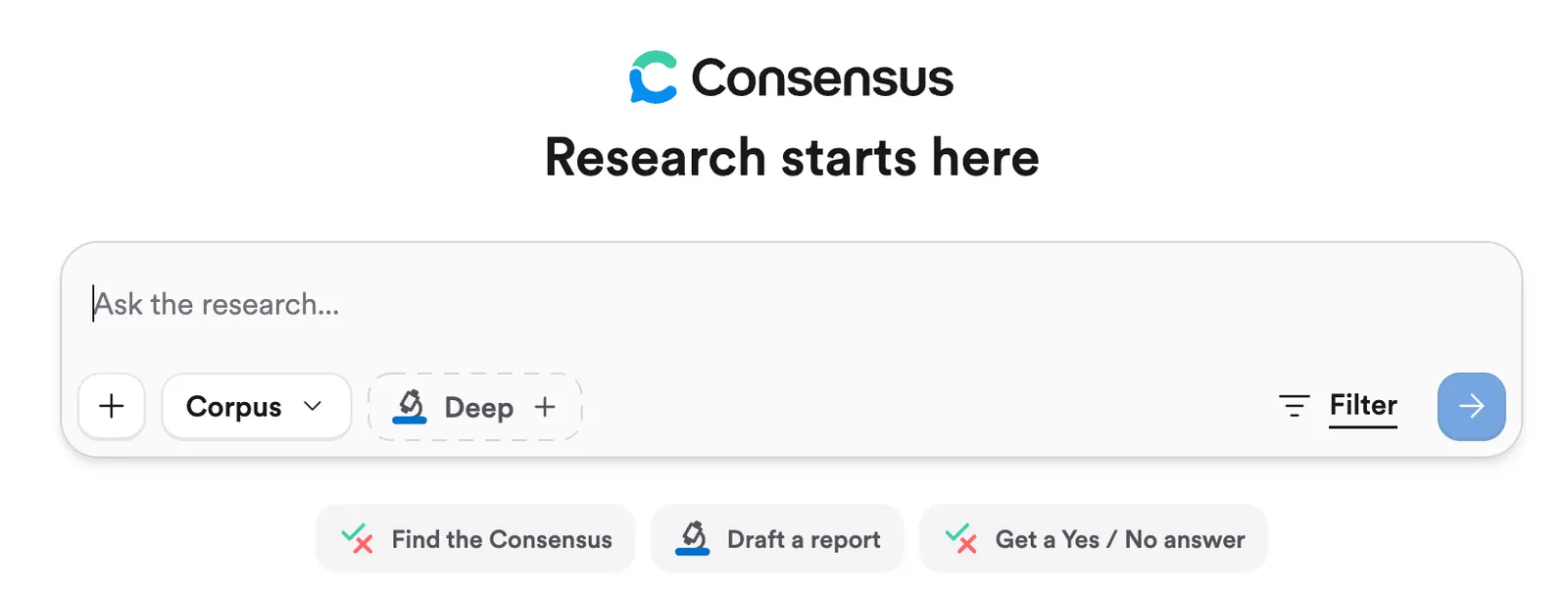
Consensus is an AI-powered academic search engine and research workspace designed to help people find, understand, compare, and synthesize scientific research.
The company was founded in 2021 by Eric Olson and Christian Salem. Consensus was created around a fairly simple idea: scientific knowledge is everywhere, but actually finding the right evidence and understanding what researchers agree or disagree about can take a huge amount of time.
Consensus publicly launched in 2022 and has since grown from an academic search product into a broader AI research platform. Today, the service searches more than 220 million research papers and offers tools for paper discovery, AI analysis, literature reviews, full-text research, collections, research visualization, and multi-step research tasks.
The company describes its mission as helping people understand and create good science. In practice, that means Consensus is less interested in giving you a generic answer and more interested in showing you what published research says about a question.
The basic workflow is straightforward:
That distinction is important. If you ask a normal chatbot a scientific question, you may get a very convincing response without immediately knowing which studies support it. Consensus starts from the research itself and builds the AI response around those sources.
🧠 What Problem Does Consensus Solve?
Academic research has a search problem.
There are millions of papers available, but finding the useful ones is often the slowest part of the job. Researchers and students may have to jump between Google Scholar, PubMed, Semantic Scholar, journal websites, PDF files, reference managers, and spreadsheets before they even start writing.
Then there is a second problem: finding papers is not the same thing as understanding the evidence.
Suppose you want to know whether poor sleep is associated with a higher risk of dementia. Searching for "sleep dementia" will return a huge amount of material. What you really want to know is which studies are relevant, what populations they examined, how strong the evidence is, and whether different studies reached the same conclusion.
Consensus is designed to shorten that process.
Instead of starting with a list of keywords, you can ask a question such as:
Consensus can then search the research literature, surface relevant studies, summarize their findings, and help you investigate disagreements in the evidence.
It does not eliminate the need to read important papers. What it does is make the first few hours of research much more manageable.
📚 Core Features of Consensus
Consensus allows users to search scientific literature using natural-language questions, keywords, Boolean queries, specific papers, authors, or more detailed research instructions. You do not have to learn a complicated academic search syntax to get started.
Pro analysis can examine up to 20 papers and generate a cited summary of the research. It is useful when you want the important findings without manually reading every abstract first.
Deep Review is designed for more complicated research questions. Consensus can break a question into smaller searches, review a much larger body of literature, identify important findings and counterpoints, and produce a structured research report.
For appropriate research questions, the Consensus Meter gives users a quick visual indication of whether the available studies generally support a claim, oppose it, or produce mixed evidence. It is useful for quickly understanding the direction of the literature.
Consensus increasingly works with full text rather than relying only on paper titles and abstracts. When eligible full text is available, users can inspect the passages behind AI-generated claims and investigate methodology, results, sample sizes, limitations, and other details.
Papers can be saved into collections and organized around a research project. Consensus also supports features such as bibliography generation, Zotero imports, DOI/RIS/BibTeX imports, and LaTeX export.
The Citation Graph helps users explore relationships between papers. This is especially useful when you have found one strong paper and want to discover related studies, earlier foundational work, or research that followed it.
Depending on the question, Consensus can generate tables, charts, timelines, Claims & Evidence Tables, Research Gaps Matrices, and other structured research outputs. These can be much easier to work with than a long block of AI-generated text.
⭐ What Makes Consensus Different?
The biggest difference is where the product starts.
A general AI chatbot starts with a language model and generates an answer. Consensus starts with academic research and then uses AI to help interpret that research.
That makes a real difference when evidence matters.
If you are writing a casual article, this distinction may not matter much. But if you are preparing a thesis, research report, scientific article, medical background report, or evidence-based piece of content, you need to know where a claim came from.
Consensus puts citations directly into its AI analysis, making it easier to move from a statement to the research supporting that statement.
Another useful feature is its ability to expose disagreement instead of simply producing a single confident answer. Scientific research is often messy. One study finds an effect, another finds a smaller effect, and another finds nothing significant.
A good research tool should help you see that uncertainty rather than hide it.
That is one reason I think Consensus is more useful than many "AI search" products when the subject is genuinely academic.
💼 Real-World Use Cases
Academic Writing
Consensus is particularly useful for essays, research papers, theses, dissertations, and literature reviews. It can help you identify relevant sources before you start building the argument.
Literature Reviews
This is probably the platform's strongest use case. Instead of manually reading a large search result list, you can use AI analysis and Deep Review to identify major findings, competing explanations, important studies, and research gaps.
Student Research
Students often know the general topic they want to research but do not know the academic vocabulary used by researchers. Consensus can help bridge that gap by letting them start with a normal question and then explore the terminology and papers that appear.
Scientific Research
Researchers can use Consensus for literature discovery, evidence synthesis, finding counterpoints, and identifying areas that need further investigation.
Medical and Health Research
Consensus can be useful for finding published research around medical and health questions. However, it should be treated as a research aid rather than a substitute for clinical judgment or professional medical advice.
Technology and R&D
R&D teams can use Consensus to investigate technical questions, compare research approaches, examine experimental results, and understand where a particular research field currently stands.
Machine Learning and Computer Science
Developers and researchers working with machine learning, computer vision, robotics, NLP, HCI, and related fields can use Consensus to find papers, compare methods, and understand research trends.
Evidence-Based Content
Writers and publishers can use Consensus when producing health, science, technology, education, psychology, or other research-heavy content. It is particularly useful when an article needs credible sources rather than generic web references.
Business Research
Consultants, strategy teams, and product researchers can use Consensus when a business question depends on scientific evidence, such as consumer behavior, learning, workplace performance, psychology, nutrition, or human performance.
🛠️ How to Use Consensus
Step 1: Create an Account
Go to the Consensus website and create a free account. The free plan is enough to test the core search experience before deciding whether you need a paid subscription.
Step 2: Start With a Research Question
Think of the search box as a research assistant rather than a traditional search engine.
Instead of:
try:
Step 3: Choose Your Search Mode
Consensus offers different research modes. A normal paper search is useful when you want to browse the literature. Pro analysis is useful when you want an AI-generated synthesis. Deep Review is better for complicated questions requiring a broader literature search.
Step 4: Review the Results
Look at the paper title, publication date, journal, authors, study design, sample size, and other available information. Do not automatically assume that the first paper is the strongest paper.
Step 5: Ask for an AI Summary
Use Pro analysis when you want Consensus to explain what the relevant papers collectively found. The generated response includes citations so you can trace the claims back to the literature.
Step 6: Go Deeper When Necessary
If the question is complicated, use Deep Review. Deep can break the question into multiple sub-questions, run targeted searches, examine a large set of papers, and produce a more detailed literature review.
Step 7: Check the Original Sources
This is the step people are most likely to skip and the step they should not skip.
If a particular finding is important to your article, thesis, or business decision, open the paper and check the original methodology and results.
Step 8: Save the Papers You Actually Need
Add useful studies to My Library and organize them into collections. This makes Consensus much more useful for projects that last weeks or months rather than a single search session.
💡 Tips for Getting Better Results
Ask a Specific Question
Broad questions usually produce broad results. Give Consensus a clear research question whenever possible.
Define the Population
If your question concerns people, explain who you mean.
Define the Outcome
Words such as "help," "better," and "effective" can be vague. Specify the outcome you care about, such as blood pressure, sleep duration, depressive symptoms, test scores, or mortality.
Ask for Comparisons
Consensus is particularly useful when you want to compare two interventions or approaches.
Ask for the Limitations
Do not only ask what the studies found. Ask what the limitations were. This often produces a much more useful research summary.
Ask for Counterevidence
If you already have an opinion, explicitly ask Consensus to find studies that disagree with it. This is a simple way to reduce confirmation bias during research.
Use Structured Outputs
For complicated projects, ask for a table, Claims & Evidence Table, Research Gaps Matrix, timeline, or other structured output rather than a long paragraph.
Do Not Confuse Citation With Proof
A citation tells you where the information came from. It does not automatically prove that the conclusion is correct. Read the paper when the claim is important.
📊 Consensus AI Analysis and Research Outputs
Consensus has moved beyond the simple "search and summarize" model.
Its current AI research features can produce:
- AI-generated research summaries
- Inline citations
- Claims & Evidence Tables
- Research Gaps Matrices
- Research timelines
- Charts and tables
- Custom visualizations
- Study Snapshots
- Paper comparisons
- Literature review reports
- Research reading lists
- Bibliographies and citation exports
The practical benefit is that you can move from "I found 30 papers" to "I understand the major findings and disagreements" much faster.
Study Snapshots are also useful when screening papers. They can surface details such as study design, population, sample size, outcomes, and study duration without forcing you to dig through every paper immediately.
🧪 Deep Review and Research Agent
Deep Review is where Consensus becomes more than a conventional academic search engine.
According to Consensus, Deep can break a complex question into multiple sub-questions, run up to 20 targeted searches, review more than 1,000 papers during the retrieval process, and typically analyze up to 50 of the most relevant papers. For some questions it may analyze up to 100 papers when the larger set improves the answer.
That makes it much better suited to questions such as:
- What does current research say about the long-term effects of intermittent fasting?
- What are the main explanations for a particular neurological condition?
- What factors are consistently associated with employee burnout?
- Which interventions are most effective for improving sleep quality?
- What are the main research gaps in a particular machine-learning field?
Consensus has also introduced a Research Agent designed to handle more complicated multi-step research tasks. Instead of simply answering one search query, it can plan searches, apply academic filters, chain together different research tools, and return citation-backed results.
This is an important change in the product's direction. Consensus is no longer positioning itself only as an academic search engine. It is becoming a research workspace where search, analysis, organization, and synthesis happen in one place.
📄 Full-Text Research Is a Major Advantage
One thing worth paying attention to is Consensus's move toward full-text research.
Academic search engines often stop at the title and abstract. That is useful, but abstracts leave out a lot of information.
The actual answer to a research question may be buried in the methodology, results, tables, limitations, or discussion section.
Consensus can use available full text from publisher sources and eligible open-access papers. When full text is used in an AI analysis, users can inspect the supporting passage behind the claim.
Users can also upload PDFs and synchronize Zotero collections, allowing Consensus to work with research material already in their own library.
For serious academic work, this is more useful than simply generating a summary from abstracts.
💻 Installation and Supported Platforms
Consensus is primarily a web-based application. You do not need to install a conventional Windows or Mac desktop program to use the core service.
| Platform | Availability | What to Expect |
|---|---|---|
| Web | Yes | The main Consensus research experience runs directly in a web browser. |
| Windows | Web-based | No traditional Windows installation is required for the core product. |
| Mac | Web-based | Use Consensus through a modern browser such as Chrome, Safari, or Firefox. |
| iPhone / iPad | Web-based | The main research workflow is accessible through a mobile browser. |
| Android | Web-based | Accessible through a mobile browser. |
| Browser Extension | Not required | The core product does not depend on a traditional browser extension. |
| ChatGPT | Yes | Consensus can be used inside ChatGPT for research grounded in its academic database. |
| Claude | Yes | Consensus can connect with Claude through its research integration and MCP workflow. |
| Microsoft 365 Copilot | Yes | Consensus is available through Microsoft Marketplace for Copilot Chat, Word, Excel, PowerPoint, and other supported workflows. |
The integration with other AI assistants is particularly interesting because it changes where research can happen. Instead of leaving ChatGPT or Claude every time you need an academic source, Consensus can bring its research capabilities into those environments.
💰 Consensus Pricing
Consensus uses a freemium model. The free plan is useful for trying the service, while the paid plans are aimed at people who conduct research regularly.
| Plan | Current Price | Main Limits and Features |
|---|---|---|
| Free | $0 | Unlimited paper searches, limited Pro messages, 3 Deep Reviews per month, 10 Study Snapshots per month, and 30 included API/MCP calls per month. |
| Pro | $20/month $144/year |
Unlimited Pro messages, 15 Deep Reviews per month, unlimited Study Snapshots, and included API/MCP usage. |
| Deep | $65/month $540/year |
Everything in Pro plus 200 Deep Reviews per month and a much larger API/MCP allowance. |
| Teams | Custom | Designed for research groups, laboratories, and academic departments with centralized billing and individual accounts. |
| Enterprise | Custom | Designed for universities, research institutions, and larger organizations that need administration, support, integrations, and larger-scale access. |
The current Pro plan costs $20 per month or $144 per year, which works out to $12 per month when billed annually.
The Deep plan costs $65 per month or $540 per year, equivalent to $45 per month when billed annually.
The free plan is actually good enough for occasional research. You can search papers without paying, which makes it easy to test Consensus before committing to a subscription.
For a student writing one thesis or dissertation, Pro is the plan I would look at first. For professional researchers, clinicians, or people doing literature reviews constantly, Deep may make sense because of its much higher Deep Review allowance.
👥 Who Should Use Consensus?
- University students: Great for essays, research papers, dissertations, and literature reviews.
- PhD students: Particularly useful when a research project involves hundreds or thousands of potentially relevant papers.
- Researchers: Useful for discovering, screening, comparing, and synthesizing scientific literature.
- Clinicians: Helpful for quickly reviewing published research, while still requiring professional judgment.
- Machine learning engineers: Useful for discovering papers and comparing research methods.
- R&D teams: Helpful when technical decisions depend on published scientific evidence.
- Technical writers: Useful when articles or reports require credible scientific sources.
- Consultants: Useful for quickly investigating specialized evidence-based questions.
- Science and health content creators: Helpful for checking claims before publishing.
- General users: Worth trying when you want to investigate a scientific claim instead of relying on social media or generic web results.
Designers, salespeople, and general office workers can use Consensus, but it is not primarily built for them. The product becomes valuable when your work depends on research evidence.
🌎 Consensus Global Usage
Consensus has grown significantly since its launch. In May 2026, the company said the platform was serving more than 2.5 million monthly active users, ranging from students to scientists and researchers.
The company has also said that more than 10 million researchers, students, clinicians, and professionals have used Consensus and that its user base spans more than 12,500 universities.
Consensus also reports more than 150 million research questions handled and more than 20 million papers shared by users.
The audience is international. The United States is naturally an important market because of its large university and research ecosystem, but the product is also relevant to academic users across Canada, the United Kingdom, Europe, India, Australia, and other research-heavy markets.
Traditional app-download numbers are not particularly meaningful here because Consensus is primarily a web application. Its monthly active users and research activity provide a much better indication of adoption.
👍 Advantages of Consensus
- Evidence-first workflow: Consensus is built around scientific papers rather than general web pages.
- Strong citation support: AI-generated findings are connected to the underlying research.
- Excellent for literature reviews: Deep Review can dramatically reduce the amount of manual searching required.
- Good at exposing disagreement: The Consensus Meter and research summaries help show when the literature is mixed.
- Large academic corpus: More than 220 million papers provide broad coverage across scientific fields.
👎 Disadvantages of Consensus
- It cannot remove scientific uncertainty: Some research questions simply do not have a clear answer.
- AI interpretation still needs verification: You should inspect the original paper when the claim matters.
- Heavy research use gets expensive: The Deep plan is aimed at professional users rather than casual researchers.
- Not a replacement for rigorous systematic review: High-stakes academic and medical work still requires human evaluation of the literature.
⚖️ Consensus vs Other Research Tools
| Tool | Main Strength | Best For | Pricing Position |
|---|---|---|---|
| Consensus | AI-powered scientific search and evidence synthesis | Understanding what published research says | Free tier; Pro from $20/month |
| Elicit | Literature research and data extraction | Finding papers and organizing research evidence | Free tier with paid options |
| Semantic Scholar | Academic paper discovery | Finding papers, authors, citations, and related research | Free for core search |
| Google Scholar | Broad academic search | Finding scholarly publications and citations | Free |
| ResearchRabbit | Visual research discovery | Mapping papers, authors, and research relationships | Free tier with paid options |
| Connected Papers | Visual similarity and citation relationships | Exploring papers related to a known starting paper | Free tier with paid options |
| Perplexity | General web research with citations | Broad internet research beyond academic papers | Free tier with paid plans |
| ChatGPT | General-purpose AI research and reasoning | Writing, analysis, coding, brainstorming, and broader research | Free tier with paid plans |
I would not choose one of these tools simply because it has "AI" in the name. They solve different problems.
Google Scholar and Semantic Scholar are excellent for conventional academic search. ResearchRabbit and Connected Papers are better when you want to explore relationships between papers visually. Elicit is strong for literature discovery and extracting information from studies.
Consensus is strongest when you want to ask a question in plain English and quickly move from the question to an evidence-backed understanding of the research.
🔍 Consensus vs ChatGPT
This is probably the most relevant comparison for everyday AI users.
ChatGPT is much broader. It can write articles, analyze files, generate code, brainstorm ideas, explain concepts, create plans, and perform many tasks that have nothing to do with academic research.
Consensus is much narrower. But that narrow focus is exactly why it can be better for scientific research.
If you ask a general AI chatbot:
you might get a very good explanation. But you still need to verify the research behind it.
Consensus starts with the research literature and builds its analysis around those sources.
So I would not say that Consensus is "better than ChatGPT." It is better at a particular job: evidence-first academic research.
The two can actually work well together. Use Consensus to find and verify the evidence, then use ChatGPT or another general AI assistant to help explain, organize, rewrite, or present that information.
📝 A Practical Consensus Workflow
If I were preparing a serious research article, this is the workflow I would actually use.
- Start with the exact question. Decide what you really need to know before searching.
- Run a paper search. Look at the first group of relevant studies and identify the strongest candidates.
- Check study design. Do not treat a randomized controlled trial, observational study, meta-analysis, and opinion piece as equivalent evidence.
- Look for disagreement. Search for studies that challenge your initial assumption.
- Use Pro analysis. Let Consensus summarize the most relevant papers and identify major findings.
- Use Deep Review when necessary. For large or complicated questions, let Deep search across a broader body of literature.
- Save important papers. Put the studies you actually care about into your library.
- Read the key papers yourself. Verify the methodology and conclusions before making strong claims.
- Only then write. Use AI to help with presentation after you understand the evidence.
This is a much safer workflow than asking an AI chatbot to generate an entire research article first and worrying about the citations afterward.
⚠️ What Consensus Cannot Do
It is easy to overestimate what an AI research tool can do.
Consensus can make literature discovery and synthesis much faster, but it does not replace research judgment.
A highly cited paper can still have methodological problems. A newer study can contradict an older study for legitimate reasons. Two studies can appear to disagree simply because they examined different populations. And sometimes the honest answer is that there is not enough high-quality evidence yet.
That is why the wrong way to use Consensus is:
The better approach is:
That is where Consensus provides real value.
🏁 Final Verdict: Is Consensus Worth Using?
Yes. Consensus is worth trying if your work regularly involves scientific or evidence-based research.
Its biggest advantage is not that it writes unusually impressive AI prose. The real advantage is the research workflow underneath the prose.
Consensus searches a huge academic corpus, identifies relevant studies, analyzes their findings, and connects the resulting claims back to research papers. That makes it considerably more useful than a generic chatbot when you need to know where information came from.
The Consensus Meter is useful for getting a quick sense of whether the literature generally points in one direction or remains divided. Deep Review is even more valuable when you have a broad research question and do not want to manually work through hundreds of search results.
The free plan is enough for occasional research. Pro is the sensible choice for students, writers, and professionals who use the platform regularly. The Deep plan is harder to justify unless you frequently conduct large literature reviews.
Who should use it? Students, PhD candidates, researchers, clinicians, R&D professionals, technical writers, science journalists, consultants, and evidence-based content creators are the clearest audience.
When is it worth paying for? When academic research is a recurring part of your job and the time saved finding and synthesizing papers is worth more than the subscription cost.
When should you skip it? If you rarely need academic sources, a free academic search engine may be enough. And if you are doing a high-stakes systematic review or making a medical or scientific decision, Consensus should be part of the workflow, not the entire workflow.
Overall, Consensus is one of the more practical AI research tools available right now. It is not trying to be an AI that does everything. It is trying to make scientific research easier to search, understand, and organize. For the right user, that specialization is exactly what makes it useful.
❓ Consensus FAQ
What is Consensus AI?
Consensus is an AI-powered academic search engine and research workspace that searches scientific literature and uses AI to summarize, compare, and synthesize research findings.
Is Consensus free?
Yes. Consensus offers a free plan with unlimited paper searches, limited advanced AI usage, three Deep Reviews per month, and other limited research features.
How much does Consensus Pro cost?
Consensus Pro currently costs $20 per month or $144 per year when billed annually, equivalent to $12 per month.
How much does Consensus Deep cost?
The Deep plan currently costs $65 per month or $540 per year when billed annually, equivalent to $45 per month.
How many papers does Consensus search?
Consensus currently searches more than 220 million research papers and uses a large academic corpus covering many scientific disciplines.
Is Consensus better than ChatGPT for research?
It depends on the research. Consensus is better suited to evidence-first academic research because its workflow is built around scientific literature. ChatGPT is much more versatile for general research, writing, coding, analysis, and reasoning.
Does Consensus provide citations?
Yes. Consensus AI analysis includes inline citations that connect claims to the research papers used in the analysis. When full text is available, users can inspect supporting passages.
Can Consensus do literature reviews?
Yes. Deep Review is specifically designed for larger research questions and can analyze a substantial set of papers to produce a structured, citation-backed literature review.
Can Consensus analyze PDFs?
Yes. Users can upload research documents and work with supported full-text material. Consensus can also connect with Zotero collections for research organization.
Is Consensus reliable?
Consensus is a useful research aid, but no AI-generated research summary should be treated as infallible. Important claims should be checked against the original paper, especially in medical, scientific, or other high-stakes situations.
Who is Consensus best for?
Consensus is best suited to students, academics, researchers, clinicians, technical professionals, R&D teams, and writers who regularly work with scientific literature.
Is Consensus worth paying for?
For people who regularly conduct academic or evidence-based research, yes. Occasional users can start with the free plan, while Pro is the more practical option for regular research and Deep is aimed at heavy literature-review workloads.
Comments