

📱 What Is Fireworks AI?
Fireworks AI is a high-performance generative AI inference platform founded in 2022 by former Meta PyTorch engineers, led by CEO Lin Qiao. It provides fast, cost-efficient API access to open-weight and open-source models across text, vision, image, audio, and multimodal modalities.
Instead of training foundation models, Fireworks AI focuses on inference, fine-tuning, and production deployment. It integrates GPU resources from multiple cloud providers and delivers them through an OpenAI-compatible API, allowing developers to run models like Llama, DeepSeek, Qwen, Mistral, Kimi, and Stable Diffusion without managing GPU infrastructure themselves.
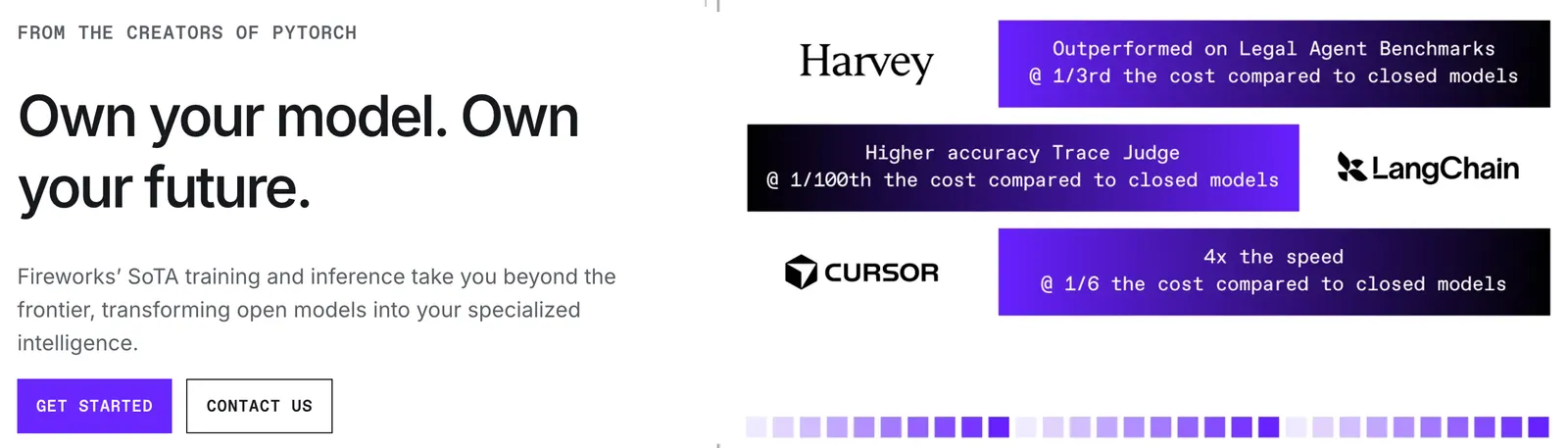
By July 2026, Fireworks AI had raised $1.51 billion in a Series D round, reaching a valuation of $17.5 billion. The company reported annualized revenue exceeding $1 billion and daily token processing above 40 trillion, serving customers such as Cursor, Uber, Samsung, Notion, Shopify, and DoorDash.
⚙️ Core Features
- Serverless Inference: pay-per-token API access to 100+ models with no infrastructure setup.
- FireAttention Inference Engine: a custom CUDA kernel that significantly accelerates context-heavy inference compared with standard open-source serving stacks.
- Fine-Tuning: supports LoRA-based supervised fine-tuning and DPO/RL-style optimization for customizing open-weight models.
- On-Demand GPU Deployment: dedicated endpoints on A100, H100, H200, B200, and other GPUs billed by the second or hour.
- Function Calling & JSON Mode: structured output and tool-use capabilities for agents, RAG, search, and workflow automation.
- Multi-Modal Support: text, vision-language, image generation, embeddings, re-ranking, and speech-to-text.
- OpenAI-Compatible API: drop-in compatibility with existing OpenAI SDKs and agent frameworks.
- Microsoft Foundry Integration: Fireworks AI models can be deployed through Microsoft Foundry on Azure for enterprise governance and billing.
- Batch Inference: discounted offline processing for large-scale evaluation, data labeling, and content generation.
- Multi-Model Routing: dynamically route requests across models by task complexity to balance cost, latency, and quality.
🌟 What Makes Fireworks AI Stand Out
Fireworks AI’s biggest strength is production-grade inference speed. Its self-developed FireAttention engine and continuous batching optimizations make it especially competitive for real-time applications such as chatbots, coding assistants, agents, and interactive search.
Unlike general-purpose cloud providers, Fireworks AI is purpose-built for open-weight model serving. It combines transparent per-token pricing, fast fine-tuning, dedicated GPU endpoints, and strong function-calling support. This makes it attractive for teams that want more control than a closed-model API but less operational burden than self-hosting.
Its ecosystem partnerships also matter. Fireworks AI is available through AWS Marketplace and Microsoft Foundry, which helps enterprise teams adopt it without leaving their existing cloud governance and billing systems.
🎯 Best Use Cases
- AI agents and copilots: function calling, JSON mode, and low-latency inference.
- RAG and search systems: embeddings, re-ranking, and multi-model routing.
- Customer-facing chatbots: fast response times and stable throughput.
- Code assistants: optimized inference for code-generation models.
- Custom model deployment: fine-tune open-weight models and serve them without managing GPUs.
- Cost-sensitive scaling: replace expensive closed-model APIs with open-weight alternatives.
- Image and multimodal apps: Stable Diffusion, FLUX, vision-language models, and Whisper-based transcription.
🚀 How to Use It
- Create an account: sign up at fireworks.ai and generate an API key.
- Choose a model: browse the model library for text, vision, image, audio, or embedding models.
- Use the OpenAI-compatible API: call Fireworks AI endpoints with standard OpenAI SDKs or REST requests.
- Enable structured output: use JSON mode or function calling when your application needs deterministic responses.
- Fine-tune if needed: upload training data and run LoRA or DPO fine-tuning jobs.
- Deploy dedicated endpoints: reserve GPUs for predictable latency and higher throughput.
- Monitor usage: track token consumption, endpoint performance, and costs in the dashboard.
💲 Pricing Overview
Fireworks AI uses usage-based pricing. Most text models are billed per million tokens, with separate rates for input and output. Image models are typically priced per inference step or per image, and speech-to-text is priced per audio minute.
As of late 2025, serverless text inference ranged from about $0.10 per million tokens for small models to around $0.90–$1.20 per million tokens for larger models, with MoE models priced according to parameter scale. DeepSeek V3 was listed at $0.50 per million input tokens and $1.68 per million output tokens, while GLM-5 was priced at $1.00 input and $3.20 output per million tokens.
Dedicated GPU endpoints are billed hourly. Example rates include roughly $2.90/hour for an A100 80GB, $4.00–$5.80/hour for an H100 80GB depending on listing date, $6.00/hour for an H200 141GB, and $9.00/hour for a B200 180GB. Batch inference typically receives a significant discount compared with real-time serverless pricing.
Actual prices vary by model, region, caching, and enterprise commitments. Always check the current Fireworks AI pricing page before estimating production costs.
👤 Who Should Use It
- AI startups: need fast, affordable inference without building GPU infrastructure.
- Engineering teams: want to self-host open-weight models but avoid operational complexity.
- Agent developers: need reliable function calling, JSON mode, and multi-model routing.
- Enterprise AI teams: want Azure/AWS-native deployment through Microsoft Foundry or AWS Marketplace.
- Cost-conscious teams: want to migrate from expensive closed-model APIs to open-weight alternatives.
🌍 Market Position
Fireworks AI competes primarily with Together AI, Groq, Baseten, Replicate, and traditional cloud AI services. Together AI is a close alternative for open-model inference and fine-tuning; Groq is stronger for ultra-low-latency workloads using specialized LPU hardware; Baseten focuses on custom model deployment; and Replicate emphasizes broad model accessibility through containerized APIs.
Fireworks AI’s differentiation lies in its combination of inference speed, open-model breadth, fine-tuning support, structured output capabilities, and enterprise cloud integrations. It is especially strong for teams that need production stability, low latency, and the ability to customize open-weight models at scale.
👍 Pros and 👎 Cons
Pros:
- Very fast inference optimized for production workloads.
- Broad support for open-weight text, vision, image, audio, and embedding models.
- Strong function calling and JSON mode for agents and RAG.
- Flexible deployment: serverless, fine-tuning, and dedicated GPUs.
- Transparent per-token pricing with batch discounts.
- Available through AWS Marketplace and Microsoft Foundry.
Cons:
- Model coverage focuses mainly on open-weight models; closed-model support is limited.
- Dedicated endpoints can add GPU idle, caching, and egress costs.
- Advanced configuration documentation may require a learning period.
- Large-scale pricing should be negotiated and monitored carefully.
- Not ideal if you need a pure multi-provider model router like OpenRouter.
⚖️ How Fireworks AI Compares to Similar Tools
- Fireworks AI vs Together AI: Both support open-model inference and fine-tuning. Fireworks AI emphasizes low-latency production inference and multimodal breadth, while Together AI is strong in high-throughput open-model workloads.
- Fireworks AI vs Groq: Groq delivers extreme decoding speed via LPU hardware but supports fewer models. Fireworks AI offers broader model coverage, fine-tuning, and dedicated GPU endpoints.
- Fireworks AI vs OpenRouter: OpenRouter excels at routing across many providers and closed models. Fireworks AI is better for optimized inference, fine-tuning, and production deployment of open-weight models.
- Fireworks AI vs AWS/Azure/GCP: Major clouds offer broader services but often higher inference costs and less specialized open-model optimization. Fireworks AI is more focused on fast, customizable model serving.
🏁 Bottom Line
Fireworks AI is one of the leading inference platforms for open-weight models. It is especially suitable for teams that need fast, reliable, and customizable model serving without operating their own GPU clusters. Its strengths include low-latency inference, fine-tuning, function calling, multimodal support, and enterprise-friendly deployment through AWS and Microsoft Foundry.
It is less suitable if you primarily need closed-model access, a pure multi-provider routing layer, or the absolute lowest possible latency from specialized inference chips. For most engineering teams building agents, RAG systems, copilots, or cost-optimized AI products, Fireworks AI is a strong and production-ready choice.
Comments