

🚀 What Is Lovable?
Lovable is an AI-powered software development platform that lets you build real websites and web applications by describing what you want in natural language. Instead of starting with a blank code editor, you can explain the product, pages, features, database logic, and user flows, then let Lovable generate and refine the application for you.
Lovable was developed by Lovable Labs and grew out of the open-source GPT Engineer project. GPT Engineer began in 2023, while the commercial Lovable platform launched in November 2024. The company's broader goal is to make software creation accessible to people who may not have traditional programming skills.
What makes Lovable different from a simple AI code generator is that it is designed around the complete application-building process. It can generate the interface, application logic, database, authentication, integrations, testing workflow, and deployment rather than simply returning a block of code.
In practical terms, Lovable is aimed at reducing the distance between “I have an idea” and “I have a working application.” That makes it particularly interesting for founders, product managers, designers, marketers, small businesses, developers, and people who need to validate an idea quickly.
🧩 Core Features
1. Natural-Language App Building
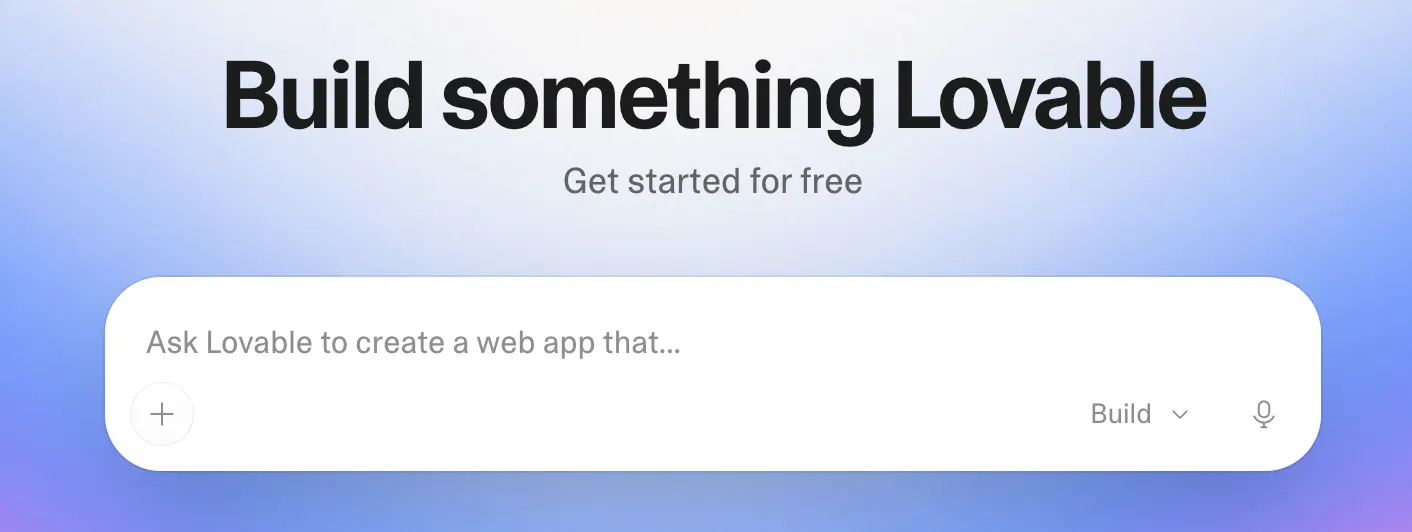
The main workflow is conversational. You describe the application you want, and Lovable turns the description into a working project. You can start with a relatively simple request such as “build a landing page for a SaaS product” and then continue refining the result through additional prompts.
2. Full-Stack Web App Generation
Lovable is not limited to visual mockups. It can create application screens, business logic, authentication, data structures, forms, dashboards, and other parts of a functional web application. This is one of the reasons it is more useful for MVP development than a traditional AI image or UI generator.
3. Built-In Backend and Cloud
Lovable Cloud provides backend capabilities for applications that need user accounts, stored data, authentication, and other server-side functionality. The company introduced Lovable Cloud in 2025 specifically to reduce the infrastructure work normally required when launching a full-stack application.
4. AI Features Inside Applications
Lovable can also add AI functionality to applications. For example, you can build a customer-support chatbot, document summarization tool, content generator, classification system, or AI-powered workflow without separately managing every model API integration.
5. Visual Refinement and Direct Code Editing
You do not have to rely entirely on prompts. Lovable allows users to refine the interface through conversation while developers can inspect and edit the generated source code when greater control is required. This creates a useful middle ground between no-code development and traditional programming.
6. Integrations
Lovable can connect applications with services such as Stripe, Google services, Shopify, Resend, ElevenLabs, Google Maps, and other integrations. This is important because a prototype becomes much more useful once it can communicate with real external services.
7. Testing and Security Assistance
Lovable includes browser-based testing and security-oriented features that help identify common problems during application development. These features do not replace professional security testing, but they can catch issues before an application reaches users.
8. Deployment and Publishing
Once an application is ready, Lovable provides one-click publishing and hosting options. This removes another common barrier for beginners: building an application is only half the job; making it accessible through a working URL is the other half.
⭐ What Makes Lovable Different?
The biggest advantage of Lovable is not simply that it can generate code. Many AI coding tools can do that. Its stronger proposition is the combination of natural-language development, application architecture, backend services, integrations, deployment, and iterative editing in one workflow.
Compared with traditional AI coding assistants, Lovable is more product-oriented. A developer using an AI coding assistant may still need to decide which framework to use, configure a database, create authentication, install dependencies, configure hosting, and connect external services. Lovable attempts to handle much of that work within the same environment.
Compared with pure no-code website builders, Lovable gives users significantly more control over application logic and source code. That matters when a prototype starts becoming a real product.
Another important difference is its target audience. Lovable was explicitly built to make software creation accessible beyond professional developers. The company's history explains this transition: GPT Engineer originally focused on developers, while Lovable expanded the concept toward non-technical builders.
💼 Practical Use Cases
Startup MVPs
Founders can use Lovable to turn a product concept into a working MVP before investing heavily in a development team. A founder can test the product concept, user flow, pricing page, onboarding process, and basic functionality with real users.
Internal Business Tools
Companies can build dashboards, inventory systems, reporting tools, employee portals, approval workflows, calculators, CRM-style interfaces, and other internal applications.
Marketing Websites
Marketing teams can create campaign landing pages, product pages, interactive calculators, lead-generation tools, event pages, and microsites without waiting for a full development cycle.
Product Design and Prototyping
Designers can move beyond static Figma screens and create clickable, functional prototypes. This makes it easier to test whether a product flow actually works rather than simply looking good in a design file.
AI-Powered Products
Teams can use Lovable to prototype AI chatbots, document analysis tools, content-generation systems, recommendation interfaces, and other AI-powered products.
Education
Students can use Lovable to understand how applications are structured by starting with natural-language requirements and then inspecting the generated code. It can also be useful for quickly building class projects and proof-of-concept applications.
Small Business Applications
A small business that needs a custom booking system, quotation tool, customer portal, reporting dashboard, or simple management application can prototype the solution without immediately commissioning a large software project.
🛠️ How to Use Lovable
Step 1: Create an Account
Open Lovable in a browser and create an account. After signing in, you can create a new project from the workspace.
Step 2: Describe the Product
Do not start with a vague request such as “make me a website.” Give Lovable enough information to understand the product.
A better prompt would be:
“Build a SaaS dashboard for a small sales team. Include email login, a dashboard showing monthly revenue, a customer list, customer details, sales pipeline, search, filters, and a simple settings page. Use a clean professional interface with responsive desktop and mobile layouts.”
Step 3: Review the First Version
Lovable will generate the initial application. Test the navigation, buttons, forms, layouts, mobile responsiveness, and overall product flow before asking for more changes.
Step 4: Iterate in Small Changes
Instead of asking the AI to completely rebuild the application after every problem, make targeted requests. For example: “Move the customer search box above the table and keep the existing filters unchanged.”
Step 5: Add Data and Integrations
Once the interface works, add authentication, database functionality, payments, email, analytics, maps, AI functionality, or other external services.
Step 6: Test Before Publishing
Do not assume that a visually attractive application is finished. Test registration, login, permissions, forms, database operations, error states, mobile layouts, and important user flows.
Step 7: Publish
When the application is ready, publish it through Lovable and connect a custom domain if required.
💡 Tips for Getting Better Results
Be Specific About the User
Instead of saying “build a dashboard,” explain who uses it. For example: “This dashboard is for sales managers who need to review team performance every morning.” The additional context changes how the interface and information hierarchy are designed.
Describe the Workflow, Not Just the Screen
AI builders work better when you explain what happens. For example: “A user submits a quotation request, the system stores it, the sales manager receives it, and the manager can approve or reject it.”
Build in Stages
A useful workflow is structure → UI → data → logic → integrations → testing → polish. Trying to generate everything in one enormous prompt can produce a complicated project that becomes harder to debug.
Use Constraints
Tell Lovable what should not change. For example: “Keep the existing navigation and database structure. Only modify the checkout page.” This reduces unnecessary changes.
Use Real Examples
If you want a particular type of interface, describe the reference clearly: “Use a compact SaaS admin layout with a left sidebar, top navigation, KPI cards, a table, and a recent activity panel.”
Check the Code When the Project Matters
For production software, do not blindly trust generated code. Review authentication, authorization, database rules, API handling, environment variables, validation, error handling, and security-sensitive operations.
Watch Your Credit Usage
Lovable uses credits for building, and the cost of a request can vary according to the complexity of the task. The official pricing documentation gives examples ranging from small visual changes to larger authentication or landing-page tasks. :contentReference[oaicite:0]{index=0}
📱 Installation and Access
Lovable is primarily a cloud-based development platform, so you can use it through a web browser without setting up a traditional local development environment.
- Web: Available through a browser and remains the primary development experience.
- Windows: A desktop application is available for supported desktop workflows.
- macOS: Desktop application support is available.
- iOS: Lovable launched its mobile application in April 2026.
- Android: A mobile application is also available.
- Browser extensions: Lovable is not primarily positioned as a browser-extension-based AI coding tool.
The iOS and Android apps are particularly useful for capturing ideas, sending text or voice prompts, monitoring builds, and continuing projects started on a computer. :contentReference[oaicite:1]{index=1}
💰 Lovable Pricing
Lovable uses a credit-based pricing model. Credits can be used for application building, Lovable Cloud usage, and AI features inside applications. This is important because the monthly subscription price alone does not tell you how much software you can actually build.
Free — $0/month
- 5 daily build credits, subject to the monthly allowance
- Monthly Cloud credits
- Limited AI feature credits
- Suitable for testing the platform and small experiments
Pro — from $25/month
- 100 monthly credits at the entry level
- Credit rollover
- Credit top-ups
- Custom domains
- Private projects
- User roles and permissions
- Removal of the Lovable badge
Business — from $50/month
- 100 monthly credits at the entry level
- Team workspace
- SSO
- Role-based access controls
- Internal publishing
- Security controls
- Design templates
Enterprise — Custom Pricing
Enterprise plans are designed for larger organizations and use volume-based credit pricing. Enterprise features can include dedicated support, onboarding, SCIM, audit logs, publishing controls, sharing controls, and other governance features.
Lovable states that plans are priced by workspace credits rather than by individual seats, so adding more collaborators does not automatically increase the subscription price. However, all collaborators share the workspace's available credit balance, so a larger team can consume that balance more quickly. :contentReference[oaicite:2]{index=2}
The entry-level Pro and Business prices are currently listed at $25 and $50 per month respectively, while Enterprise pricing is customized. Because Lovable's credit structure and plan details can change, the live pricing page should be treated as the final reference before purchasing. :contentReference[oaicite:3]{index=3}
🌎 Global Usage and Market Presence
Lovable has grown well beyond the early AI-coding community. In August 2026, the company said users had created more than 60 million projects since the November 2024 launch, while applications built with Lovable were receiving more than 900 million visits per month. The company also said that nearly two-thirds of Fortune 500 companies had employees using Lovable. :contentReference[oaicite:4]{index=4}
Lovable had already reported nearly 8 million users by November 2025, following 2.3 million active users reported earlier that year. These figures show how quickly the product expanded from an AI coding experiment into a broader software-creation platform. :contentReference[oaicite:5]{index=5}
Independent technology-usage data also shows a strong international footprint. Similarweb's technology dataset identified more than 88,000 websites using Lovable as of September 12, 2026. Its reported distribution of identified sites was led by the United States, followed by Brazil and India. These figures measure detected websites rather than total Lovable users, so they should not be treated as a direct user-count measurement. :contentReference[oaicite:6]{index=6}
The overall picture is clear: Lovable has moved from a developer-focused experiment toward a global platform used by developers, founders, designers, businesses, students, and non-technical builders.
⚖️ Pros and Cons
Advantages
- Very fast idea-to-prototype workflow: A functional application can be produced much faster than starting a project completely from scratch.
- Accessible to non-developers: Users can work primarily through natural-language instructions.
- More than a UI generator: Lovable can handle application logic, data, authentication, integrations, and deployment.
- Code remains accessible: Developers can inspect and modify the generated source rather than being permanently locked into a visual editor.
- Strong ecosystem: Cloud, AI, integrations, mobile access, collaboration, and deployment make it useful beyond the initial prototype.
Disadvantages
- Credit consumption can become significant: Larger projects and repeated iterations can use credits quickly.
- AI-generated code still needs supervision: A working interface does not automatically mean the underlying architecture, security, or business logic is production-ready.
- Complex projects require more discipline: As the application grows, poorly structured prompts and uncontrolled AI changes can make the project harder to maintain.
- Less control than a fully manual development stack: Developers with very specific architecture, infrastructure, or framework requirements may prefer a conventional development environment.
🔍 Lovable vs. Other AI Development Tools
| Tool Type | Primary Strength | Typical User | Best Use Case | Key Difference from Lovable |
|---|---|---|---|---|
| Lovable | Full-stack app creation through natural language | Founders, developers, designers, businesses | MVPs, SaaS apps, internal tools, web products | Combines AI development, backend, integrations, hosting, and iterative product development |
| v0 | AI-generated interfaces and application development | Developers and designers | React interfaces, prototypes, modern web applications | Often attractive when the developer wants a frontend-first workflow |
| Replit | Cloud development environment plus AI assistance | Developers and learners | Building and running software directly in a cloud IDE | More closely resembles a complete cloud development environment |
| Bolt | Prompt-based application generation | Developers, designers, entrepreneurs | Rapid web development and prototyping | Similar AI-first workflow, with differences in architecture, integrations, deployment, and pricing |
| Cursor | AI-assisted coding inside a developer-oriented editor | Professional developers | Maintaining and developing larger codebases | More suitable when the developer wants direct control over the existing codebase and development environment |
| Traditional IDE + AI | Maximum development control | Professional developers | Complex production software | More setup and technical knowledge, but greater control over architecture and infrastructure |
The important point is that these products are not interchangeable. Lovable is strongest when the goal is to move quickly from an idea to a working web application. A developer maintaining a large existing production codebase may have very different requirements from a founder trying to validate a new product in a weekend.
👥 Who Should Use Lovable?
- Founders: Useful for testing an idea before spending heavily on development.
- Product managers: Useful for turning product requirements into functional prototypes.
- Designers: Useful for transforming interface concepts into working experiences.
- Developers: Useful for accelerating boilerplate development, prototypes, internal tools, and feature experiments.
- Marketers: Useful for interactive campaigns, landing pages, calculators, lead-generation tools, and microsites.
- Small businesses: Useful for custom business tools that do not justify a large development budget.
- Students: Useful for learning application concepts and quickly building projects.
- Non-technical users: Useful when the main obstacle is turning a business idea into working software.
🧠 Is Lovable Worth Using?
Lovable is worth considering if your main problem is speed: you have an application idea, but building the first usable version would normally require weeks of development work or a development team.
It is especially practical for MVPs, prototypes, internal business tools, marketing applications, dashboards, customer portals, and early-stage SaaS products. The combination of natural-language development, backend functionality, integrations, hosting, and editable source code makes it more useful than an AI tool that only generates isolated snippets.
However, there is an important distinction between building an application and building reliable software. Lovable can dramatically reduce the first problem. It does not eliminate the second. Production applications still need proper requirements, testing, security review, data protection, error handling, monitoring, and human technical judgment.
If you are a non-technical founder who wants to validate an idea, Lovable can shorten the path from concept to something real. If you are an experienced developer working on a highly customized system with strict infrastructure requirements, a traditional development environment or AI coding IDE may provide more control.
Bottom line: Lovable is best understood as an AI-powered software creation platform rather than simply an “AI coding tool.” Its real value is the ability to move from product idea to working web application with relatively little infrastructure work. For rapid MVP development and experimentation, that workflow can be genuinely useful. For complex production systems, treat the generated application as a starting point that still requires engineering review.
Comments